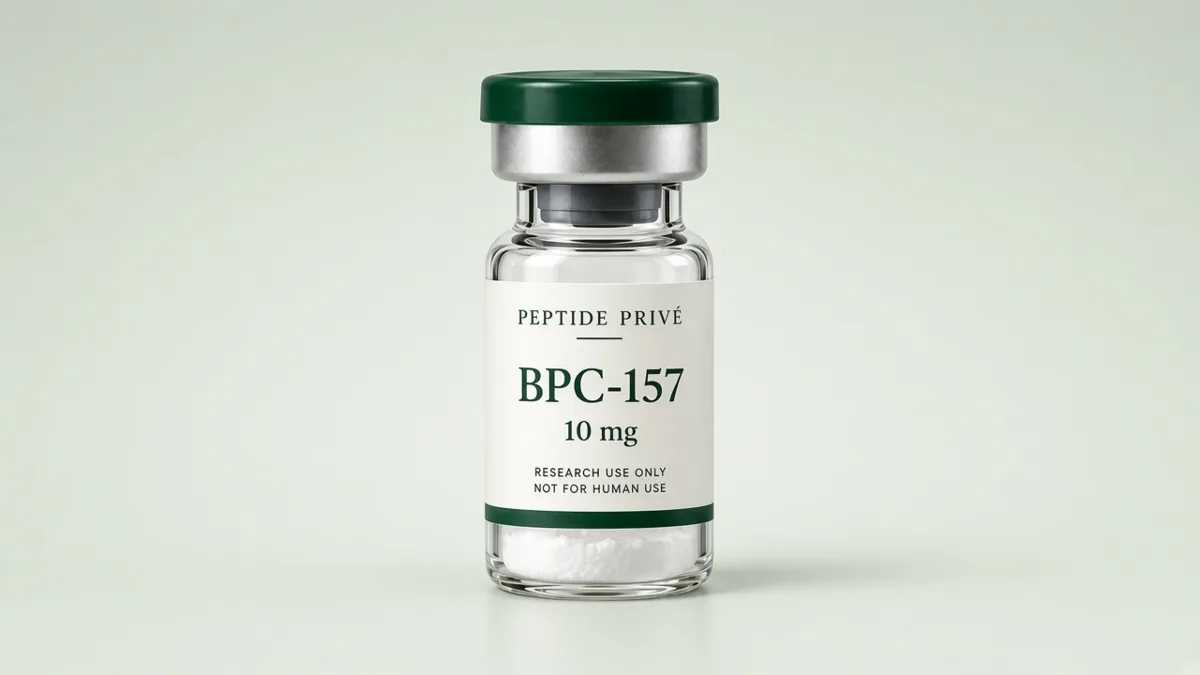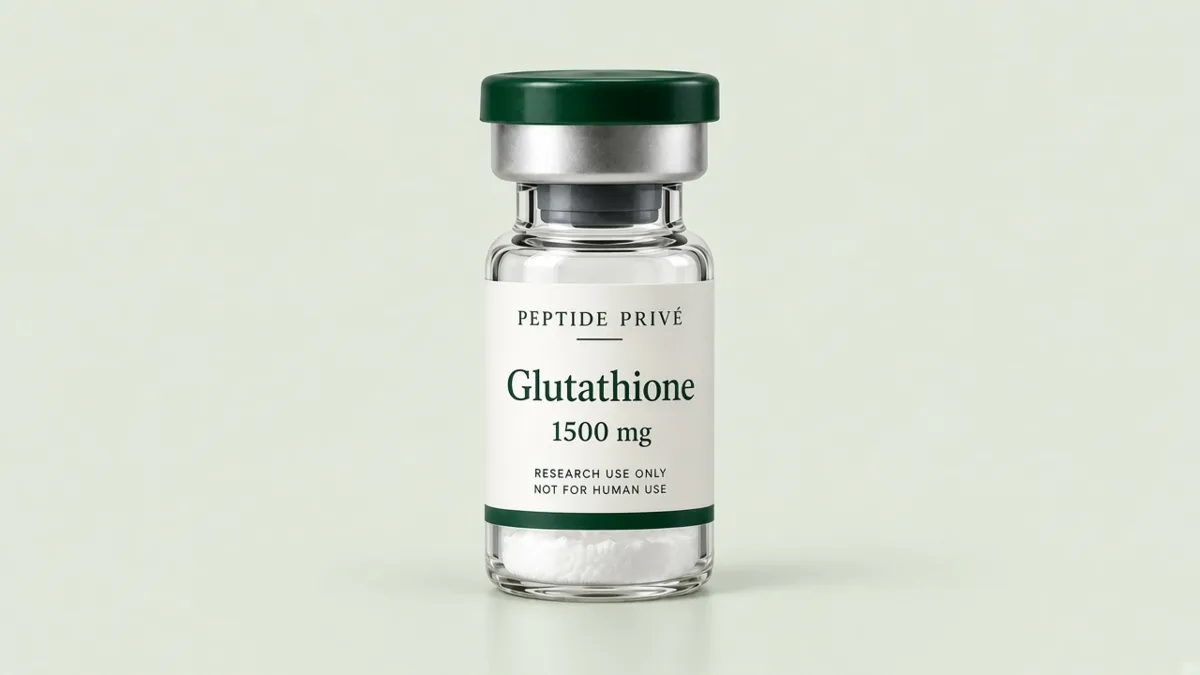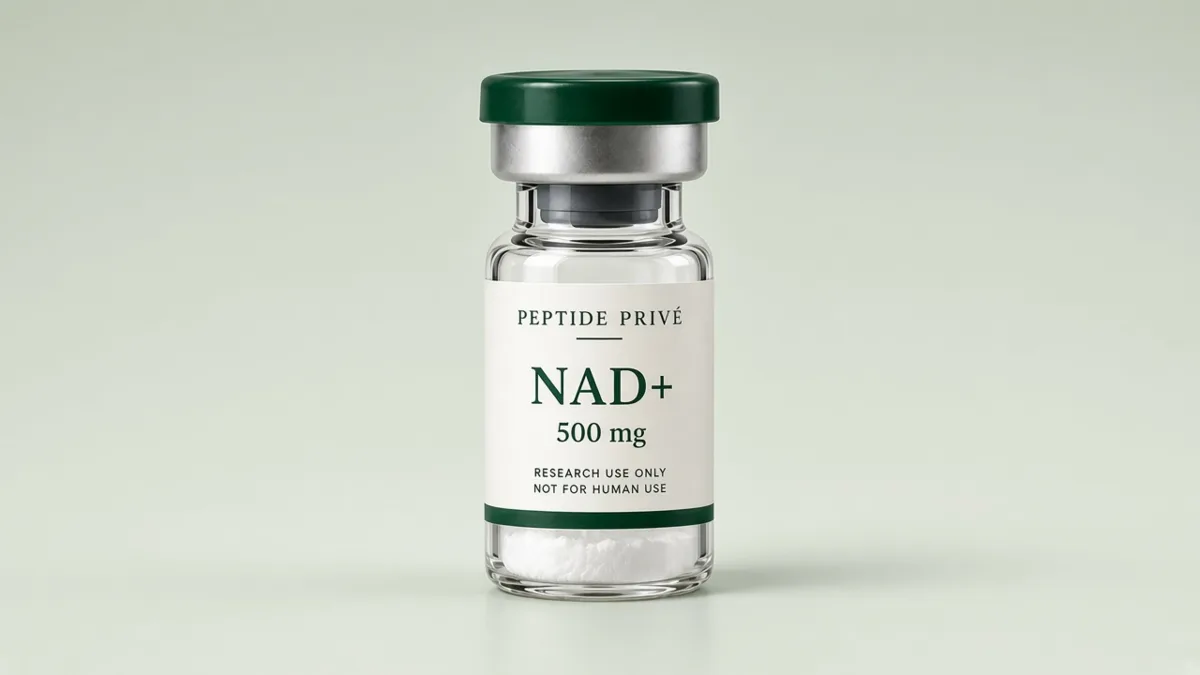
Lyophilized (freeze-dried) peptides are comparatively stable, but temperature, moisture, light and air still affect them over time. Consistent storage keeps your results comparable from one experiment to the next, and it means that if a result drifts, storage can be ruled in or out quickly.
Why the Dry Form Is the Stable Form
Most of the chemical reactions that slowly change a peptide need water, either as a reactant or as a medium that lets molecules move. Freeze-drying removes most of that water. Reviews of pharmaceutical freeze-drying describe the solid state as markedly more stable for proteins and peptides that are only marginally stable in solution, largely because molecular mobility in the dry solid is low (Izutsu 2018).
The same literature is clear that "dry" does not mean "permanent". Solid protein and peptide materials can still change during long-term storage, and the rate depends on residual moisture, temperature and the composition of the solid (Wang 2000). Good storage is about keeping the material in the low-mobility, low-moisture state it was supplied in.
The Four Things That Act on a Peptide
| Factor | What it does | What the lab controls |
|---|---|---|
| Temperature | Higher temperature speeds up nearly every degradation reaction | Cold storage, short time at the bench |
| Moisture | Water raises molecular mobility and feeds hydrolysis and deamidation | Sealed vials, warming before opening, quick reclosing |
| Light | UV and visible light can oxidize certain amino acid side chains | Opaque storage, boxes, no window sills |
| Oxygen | Oxidizes sensitive residues, especially with light or trace metals present | Minimal headspace exposure, closed vials |
Moisture: the factor labs most often get wrong
A vial taken straight from a freezer is colder than the room's dew point. If it is opened right away, moisture from the air condenses on the glass and the powder. Lyophilized peptide powders are often hygroscopic, so that water can stay behind after the vial is closed again. Letting the closed vial reach room temperature first, typically in a desiccator or on the bench for a short period, avoids this.
Moisture matters chemically as well as physically. Asparagine and, more slowly, aspartic acid residues can rearrange through a cyclic succinimide intermediate, producing deamidated, isomerized (isoaspartyl) and racemized forms. In a classic model-peptide study, an Asn-Gly sequence deamidated with a half-life of about 1.4 days at 37 °C and pH 7.4, while an Asp-containing analogue formed the succinimide about 34 times more slowly (Geiger & Clarke 1987). Those numbers are for a peptide in solution at body temperature, which is exactly why a dry, cold solid behaves so differently.
Light and oxygen: residue-specific
Photo-oxidation is not uniform across a sequence. Direct UV damage centers on tryptophan, tyrosine, histidine and cystine. Indirect damage through singlet oxygen also reaches cysteine and methionine (Pattison et al. 2012). A peptide with none of these residues is less exposed to this pathway; one with several is more exposed. Reading the sequence on the product page tells you which case you have.
Temperature: slow everything down
Long-term storage of sealed vials at −20 °C is common practice in research labs, and some labs use −80 °C for long holds. Always follow the storage line on the product page and the vial label, which takes precedence over general guidance.
Before Opening
- Store sealed vials cold and dry. Long-term storage at −20 °C is common practice; follow the storage line on the product page and the vial label.
- Keep vials away from direct light, inside their box or an opaque container.
- Let a cold vial reach room temperature before opening it. Opening a cold vial draws in moisture from the air, which can condense on the powder.
- Inspect the cake or powder. A lyophilized peptide is usually a white to off-white solid. A collapsed, sticky or discolored cake is worth noting in your records before use.
After Opening
- Close the vial promptly and return it to cold storage.
- Weigh what you need quickly, in a low-humidity area if possible.
- Minimize freeze–thaw cycles. If you will use the material over several sessions, divide it into single-use aliquots at the start.
- Record the date opened on the label.
Solutions: Where Stability Drops
Once a peptide is in solution, its stability depends on the solvent, pH, concentration, temperature and container. Several general points from the stability literature are useful when writing a protocol:
- Chemistry speeds up in water. Deamidation, isomerization, hydrolysis and oxidation all proceed faster in solution than in the dry solid (Manning et al. 2010).
- Freezing is a stress of its own. Freezing concentrates solutes and creates ice–liquid interfaces. A 2026 study using a model protein found that aggregation during freezing was driven mainly by interfacial stresses rather than by dissolved oxygen (Miyahara et al. 2026). Repeated freeze–thaw cycles repeat that stress, which is why single-use aliquots are preferred.
- Peptides stick to surfaces. At low concentrations, a measurable fraction of a peptide can adsorb to pipette tips, tubes and vials, which lowers the amount actually in solution. Analytical chemists regard this as a known source of bias, and the right solvent and container material depend on the peptide (Maes et al. 2014).
Prepare solutions according to your protocol, store them as the protocol specifies, and label each container with the compound, concentration, solvent, date and lot number.
Aliquoting Without Losing Track
- Plan the number of aliquots before opening the vial, based on the experiments you expect to run.
- Use the same tube type for every aliquot of a lot, so surface effects are consistent.
- Give each aliquot a short code that maps to a line in your notebook (lot number, amount, solvent, date, initials).
- Store aliquots together, in one labeled box, so the lot is never split across locations.
- Discard partly used aliquots instead of refreezing them.
Labeling and Traceability
Keep the lot number with every aliquot and solution. It links your material to its analytical report and makes troubleshooting possible if results drift. A practical minimum for each label:
| Field | Example |
|---|---|
| Compound | BPC-157 |
| Lot number | as printed on the vial |
| Form | powder, or solution with solvent and concentration |
| Date | received, opened, prepared |
| Storage | −20 °C, protected from light |
| Initials | who prepared it |
How We Ship and Store
Lyophilized materials are kept cool, dry and protected from light until they ship. Vials travel in a rigid two-piece board box with die-cut foam wells, and every vial is batch-numbered so it can be matched to its lot.
Disposal
Dispose of unused material and solutions according to your institution's chemical waste procedures.
Sources
- Izutsu KI. Applications of Freezing and Freeze-Drying in Pharmaceutical Formulations. Adv Exp Med Biol. 2018. PubMed 30288720: https://pubmed.ncbi.nlm.nih.gov/30288720/
- Wang W. Lyophilization and development of solid protein pharmaceuticals. Int J Pharm. 2000. PubMed 10967427: https://pubmed.ncbi.nlm.nih.gov/10967427/
- Geiger T, Clarke S. Deamidation, isomerization, and racemization at asparaginyl and aspartyl residues in peptides. J Biol Chem. 1987. PubMed 3805008: https://pubmed.ncbi.nlm.nih.gov/3805008/
- Pattison DI, Rahmanto AS, Davies MJ. Photo-oxidation of proteins. Photochem Photobiol Sci. 2012. PubMed 21858349: https://pubmed.ncbi.nlm.nih.gov/21858349/
- Manning MC et al. Stability of protein pharmaceuticals: an update. Pharm Res. 2010. PubMed 20143256: https://pubmed.ncbi.nlm.nih.gov/20143256/
- Miyahara Y, Nagel R, Frieß W. Dissolved oxygen effects on human growth hormone stability during freeze-thaw and metal-catalyzed oxidation. J Pharm Sci. 2026. PubMed 42097404: https://pubmed.ncbi.nlm.nih.gov/42097404/
- Maes K et al. Strategies to reduce aspecific adsorption of peptides and proteins in LC-MS based bioanalyses: an overview. J Chromatogr A. 2014. PubMed 25022477: https://pubmed.ncbi.nlm.nih.gov/25022477/
Further Reading
For in-vitro laboratory research only. Not for human or animal use.