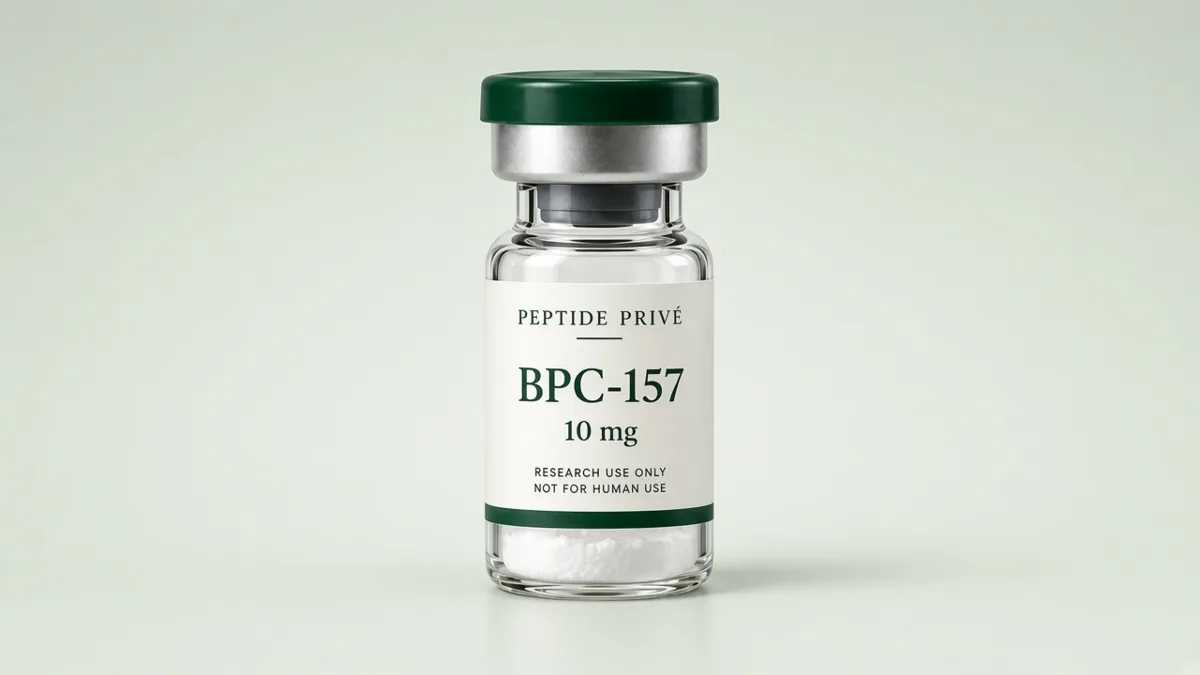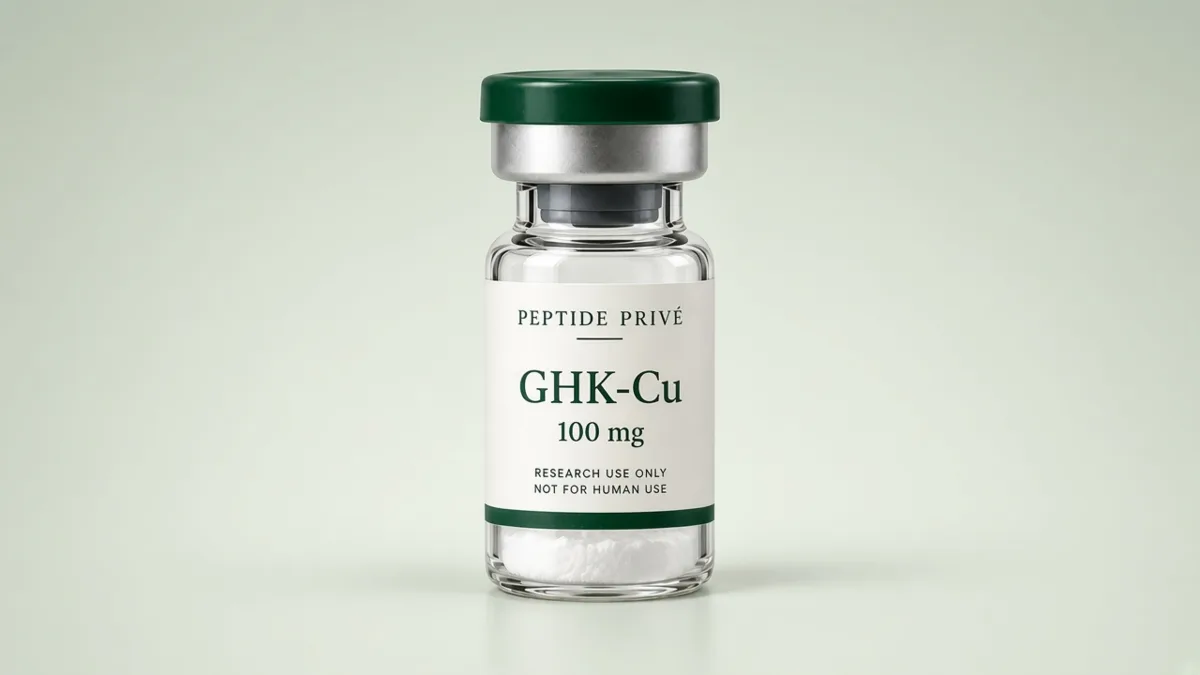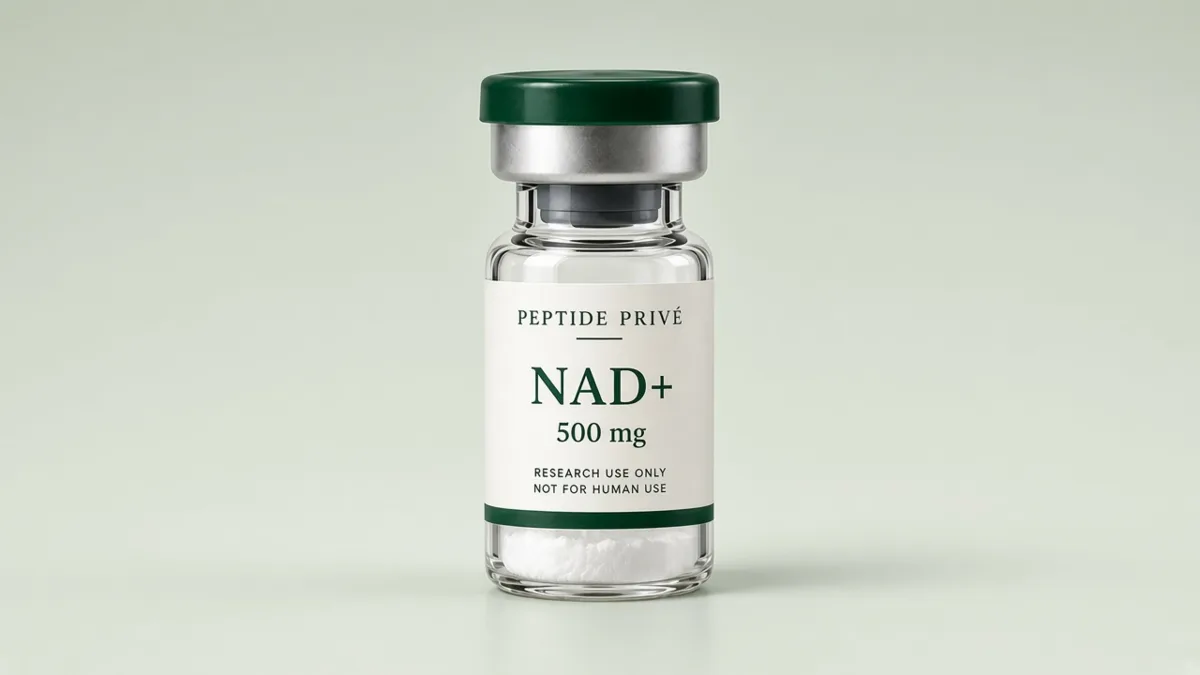
Most research peptides arrive as a small dry cake or powder at the bottom of a vial. That format is deliberate. This guide explains why, and what the appearance of the powder can and cannot tell you.
Why Not a Liquid?
Many peptides are only marginally stable in water. In solution, they can slowly break down through reactions such as hydrolysis and oxidation, and the rate depends on temperature, pH and time. Removing the water greatly slows these processes.
A 2018 review by Izutsu describes how freeze-drying improves the storage stability of proteins, peptides and other molecules that are only marginally stable in aqueous solution.
What "Lyophilized" Means
Lyophilization is the technical name for freeze-drying. The process has three stages:
| Stage | What happens |
|---|---|
| Freezing | The solution is frozen solid |
| Primary drying | Under vacuum, ice turns directly into vapor (sublimation) |
| Secondary drying | Remaining bound water is removed |
What is left is a dry, porous solid, often called a cake. It may look like a firm puck, a loose powder, or a cake that has shrunk or cracked during transit. Those physical differences are normal and do not change what the vial contains.
Light: The Other Factor
Moisture is not the only concern. Light, especially ultraviolet light, can damage proteins and peptides. A review by Pattison and colleagues explains that direct light damage mainly affects a small group of amino acids, principally tryptophan, tyrosine, histidine and disulfide-linked cystine, and that oxygen-driven reactions can affect others, such as methionine and cysteine.
Why some powders look slightly yellow
When these light-sensitive amino acids react, some of the products absorb visible light and appear yellow. Research on wool proteins, which turn yellow with sun exposure, has characterized tryptophan- and tyrosine-derived colored products of exactly this kind.
So a faint tint can be a clue that some change has occurred. It is not a verdict. Some compounds also have a natural color: GHK-Cu, for example, is blue because of its bound copper. The only way to know whether a lot meets its specification is the analytical report.
How Our Vials Are Handled
- Lyophilized materials are kept cool, dry and protected from light until they ship.
- Every vial is batch-numbered for traceability to its lot.
- Orders ship in a rigid two-piece board box with die-cut foam wells, in discreet packaging, with tracking.
What to Do When a Vial Arrives
- Record the lot number on the vial in your lab notes.
- Store it cold, dry and away from light as soon as possible.
- Let a cold vial reach room temperature before opening.
- If the powder looks unusual, contact our team with your order and lot numbers before use.
Our guide on Storing Lyophilized Peptides in the Lab covers storage after opening, aliquoting and labeling.
FAQ
Is a loose powder worse than a solid cake? Not by itself. The cake can shift or break during transit. Identity and purity are confirmed by the report, not the cake's shape.
Does a yellow tint mean a vial is unusable? Not necessarily. It is a reason to check the lot's report and your storage conditions.
Why keep vials away from light if they are sealed? A seal keeps out moisture and air, but light can pass through clear glass.
Sources
- Izutsu KI. Advances in Experimental Medicine and Biology, 2018. PubMed 30288720: https://pubmed.ncbi.nlm.nih.gov/30288720/
- Pattison DI, Rahmanto AS, Davies MJ. Photochemical & Photobiological Sciences, 2012. PubMed 21858349: https://pubmed.ncbi.nlm.nih.gov/21858349/
- Dyer JM et al. Photochemical & Photobiological Sciences, 2006. PubMed 16820857: https://pubmed.ncbi.nlm.nih.gov/16820857/
For in-vitro laboratory research only. Not for human or animal use.