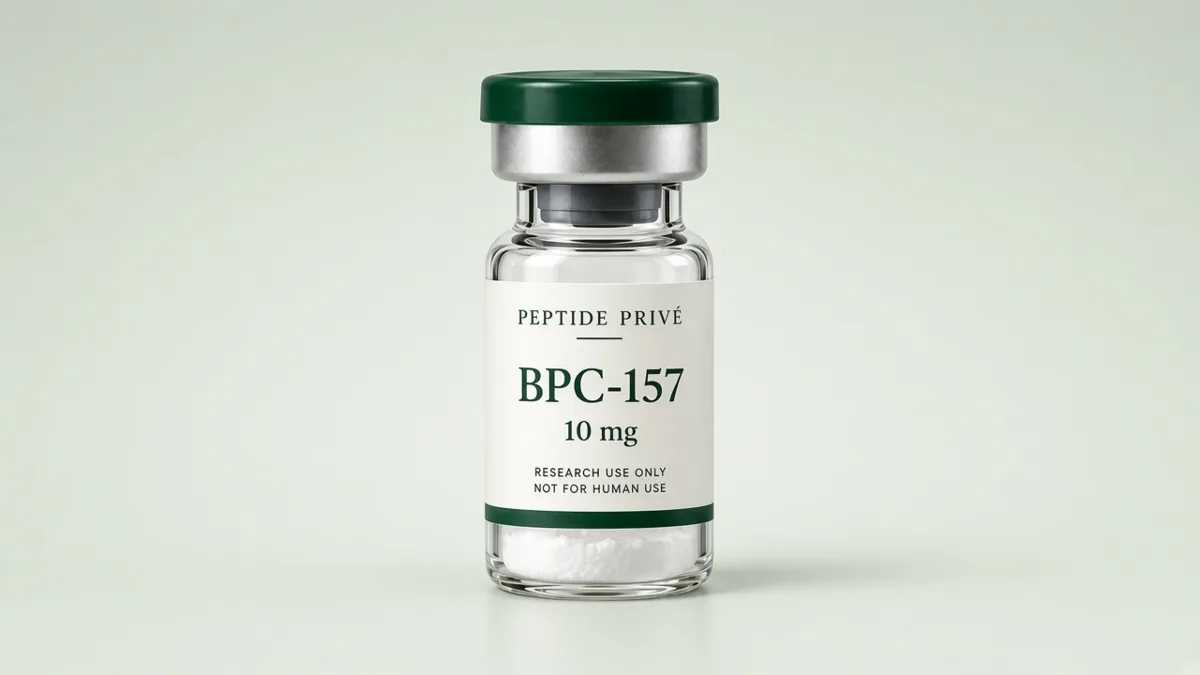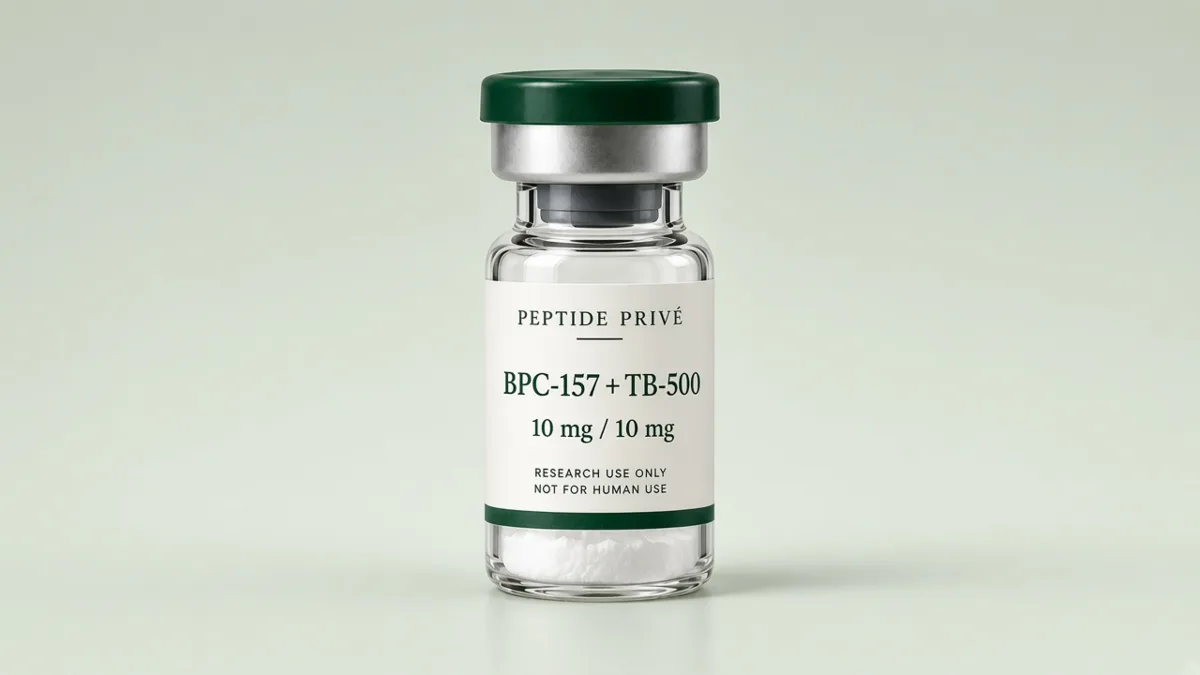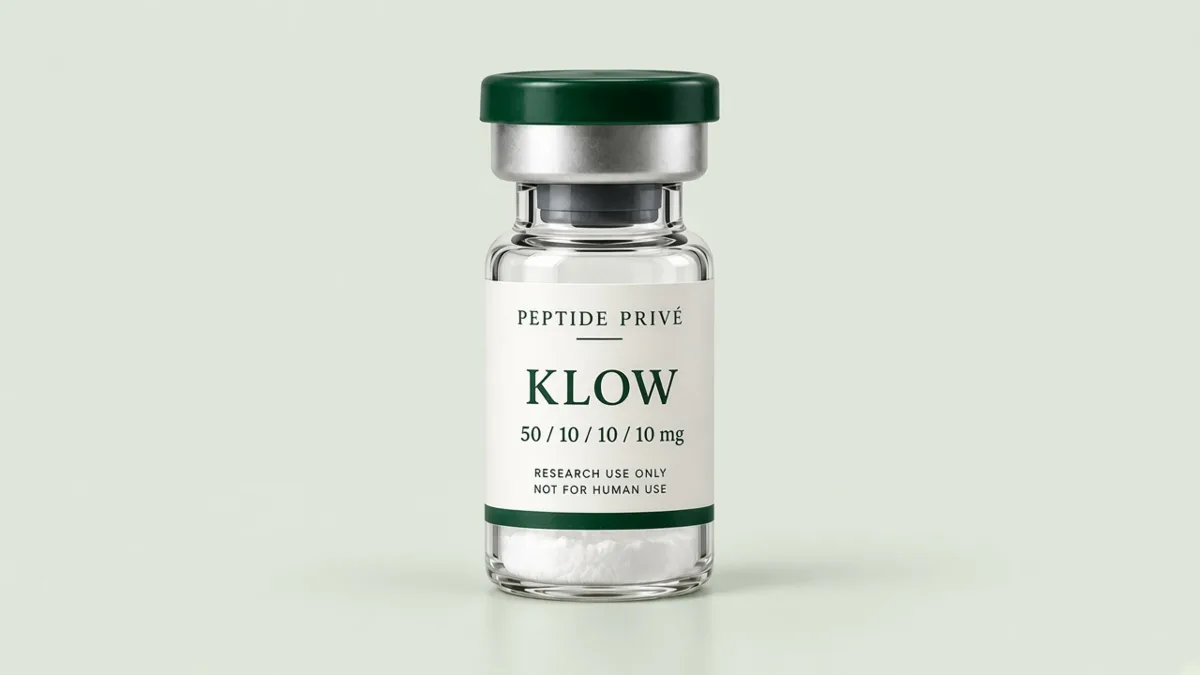
A label tells you what a vial is supposed to contain. A country of origin tells you where something was made. Neither one confirms what is actually inside. That job belongs to analytical testing, tied to a specific lot.
What a Label Can and Cannot Tell You
| Information | What it tells you | What it cannot tell you |
|---|---|---|
| Compound name | What the material is meant to be | Whether the molecule is correct |
| Amount (mg) | The intended quantity | The measured content |
| Country of origin | Where a step took place | Identity, purity or cleanliness |
| Lot number | Which batch the vial belongs to | Anything, until matched to a report |
Raw materials and finished goods often pass through more than one location before they reach a laboratory. The same molecule is held to the same tests, wherever it was made.
Why Testing Matters More for Peptides Than It Seems
A synthetic peptide is built one amino acid at a time. Each coupling and deprotection step is very efficient but not perfect, and a 15-residue peptide goes through dozens of chemical steps. The by-products are not random junk; they are near-copies of the target. A structured review of peptide impurities lists deletion and insertion sequences, diastereomers from racemization, incompletely deprotected forms, oxidized forms and degradation products such as succinimide, pyroglutamate and diketopiperazine species (D'Hondt et al. 2014). The same review notes that such impurities can distort early functional studies and lead to wrong conclusions, which is the core reason a research lab should care.
The review also reports cases where peptide products were contaminated by entirely unrelated peptides, which it attributes to inadequate manufacturing practice (D'Hondt et al. 2014). No label would reveal that. Only testing does.
The Three Questions Testing Answers
1. Is it the right molecule? (Identity)
Mass spectrometry (MS) measures the mass of the molecule and compares it with the expected value. For a peptide, the observed mass should agree with the theoretical molar mass within the method's stated tolerance. MS is often coupled with liquid chromatography (LC-MS).
A mass match is necessary but not always sufficient. Two peptides with the same amino acids in a different order have the same mass, and so do L- and D-forms of the same sequence. Fragmentation (MS/MS) can confirm the order of residues, and a chromatographic comparison with a reference standard adds a second, independent line of evidence.
2. How much of it is the main compound? (Purity)
High-performance liquid chromatography (HPLC) separates the main compound from related substances. Purity is reported as the main peak's share of the total peak area at a stated wavelength, for example 214 nm for peptide bonds.
Because many impurities differ from the target by a single residue, some elute very close to the main peak. That is why regulators reviewing synthetic peptide drug applications ask for orthogonal methods, separations that rely on different chemistry, so that an impurity hidden in one method is revealed by another (FDA SBIA presentation, 2022). High-resolution LC-MS adds another layer: an FDA laboratory showed that it could quantify impurities below 0.1% even when they co-eluted with the main compound (Zeng et al. 2015).
3. Is it within limits for specific contaminants? (Contaminant tests)
Depending on the panel, a report may include tests such as endotoxin, residual solvents or heavy metals. Each is a measured value against a limit. See What "Endotoxin" Means on a Lab Report.
For residual solvents, the ICH Q3C guideline is the common reference point. It sorts solvents into three classes by toxicity. Several solvents used in peptide synthesis and purification, including acetonitrile, dimethylformamide and dichloromethane, are Class 2 solvents to be limited; diethyl ether is Class 3; trifluoroacetic acid is listed among solvents with no adequate toxicological data (ICH Q3C(R9)).
A Fourth Question: How Much Peptide Is in the Powder? (Content)
Purity and content are different questions. A lyophilized peptide is a salt that also holds residual water. Peptides purified by reversed-phase HPLC are commonly isolated as trifluoroacetate salts, sometimes with excess counter-ion (Sikora et al. 2018). None of this appears in an HPLC purity figure. When a report gives net peptide content, water content or counter-ion content, it is answering this fourth question.
Why Every Report Belongs to One Lot
An analytical report describes a sample taken from one production lot. The sample that was tested is consumed in the process, so the report is a record of that lot, not of the individual vial in your hand. That is why traceability matters:
- The lot number on your vial must match the lot number on the report.
- A report for a different lot, however good, says nothing about your material.
- Keep the lot number on every aliquot and solution you prepare, so results can be traced back if something drifts.
How We Apply This
- Every Peptide Privé vial is batch-numbered, so each order can be traced back to its lot.
- Every Peptide Privé batch is tested by an independent lab.
- Product pages list identity data and the documented lot purity by HPLC.
Questions to Ask of Any Lot
- Does the lot number on the report match the vial?
- Does the observed mass match the expected mass for this compound, and which ion is quoted?
- What is the HPLC purity, and at what wavelength and method?
- Is net peptide content, water or counter-ion content reported, or only purity?
- Which other tests were run, and what were the limits?
- Who performed the testing, and when?
FAQ
Does a country of origin tell me anything about quality? It tells you where a step happened. Quality is shown by test results for the specific lot.
Is "research use only" a quality grade? No. It describes intended use, not purity. See What "Research Use Only" Means.
Why can't a report be reused for a later lot? Each lot is made and tested separately. Results do not carry over from one lot to the next.
If the purity is 99%, is 99% of the powder peptide? Not necessarily. Purity describes the peptide-related species the detector sees. Water and counter-ions are not counted, so the peptide share of the weighed powder is usually lower.
For a field-by-field walkthrough of a report, read How to Read a Peptide Analytical Report.
Sources
- D'Hondt M et al. Related impurities in peptide medicines. J Pharm Biomed Anal. 2014. PubMed 25044089: https://pubmed.ncbi.nlm.nih.gov/25044089/
- Zeng K et al. Liquid Chromatography-High Resolution Mass Spectrometry for Peptide Drug Quality Control. AAPS J. 2015. PubMed 25716148: https://pubmed.ncbi.nlm.nih.gov/25716148/
- Sikora K et al. Counter-ion effect on antistaphylococcal activity and cytotoxicity of selected antimicrobial peptides. Amino Acids. 2018. PubMed 29307075: https://pubmed.ncbi.nlm.nih.gov/29307075/
- U.S. FDA, SBIA 2022 presentation on peptide-related impurities in synthetic peptide ANDAs: https://www.fda.gov/media/166572/download
- ICH Q3C(R9) Guideline for Residual Solvents (2024): https://database.ich.org/sites/default/files/ICH_Q3C%28R9%29_Guideline_MinorRevision_2024_2024_Approved.pdf
For in-vitro laboratory research only. Not for human or animal use.