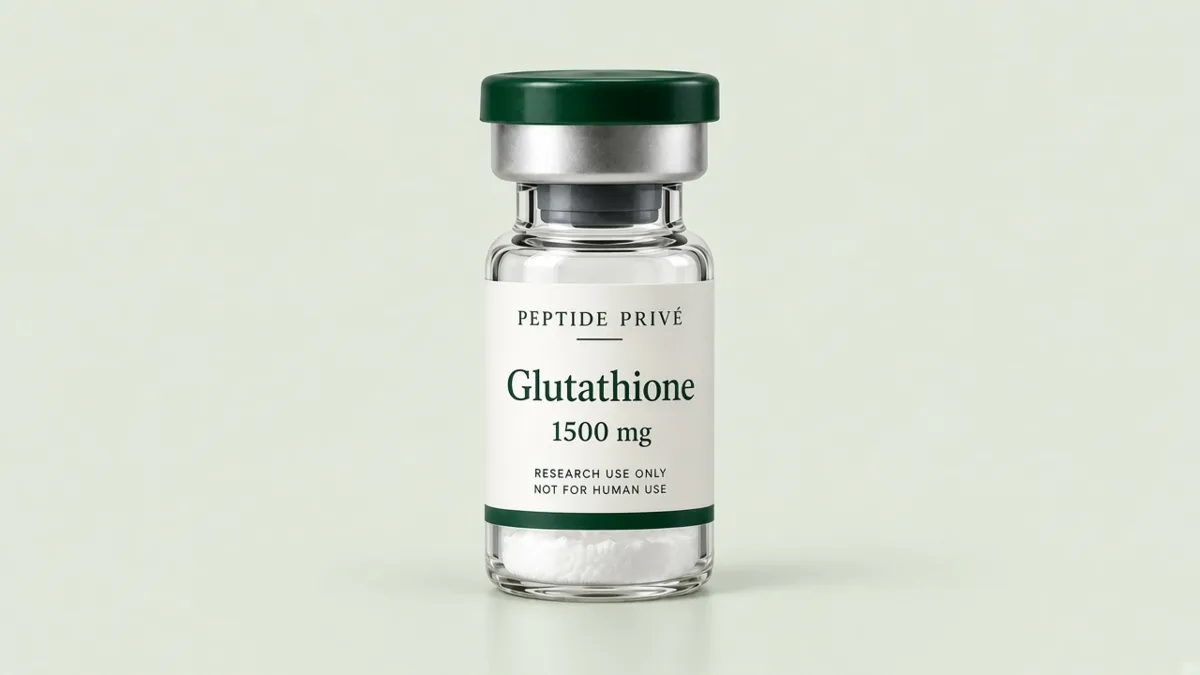
Glutathione is the oldest and best-characterized small thiol in cell biology textbooks, and it is also a peptide with an unusual bond. For a lab, the practical question is not what glutathione does in a cell, but which form is in the vial and whether it stayed in that form.
What Glutathione Is
Glutathione (GSH) is a tripeptide of glutamate, cysteine and glycine. Unlike most peptides in a catalog, the first bond is not the usual α-peptide link: the glutamate is joined through its side-chain (γ) carboxyl group to the cysteine. That is why it is written γ-Glu-Cys-Gly and why ordinary protease-based reasoning about peptide stability does not carry over cleanly.
| Property | Value |
|---|---|
| Sequence | γ-Glu-Cys-Gly |
| Common names | L-Glutathione (reduced), GSH |
| CAS number | 70-18-8 |
| Molecular formula | C10H17N3O6S |
| Molar mass | 307.32 g/mol |
| Oxidized form | Glutathione disulfide (GSSG), two GSH joined by a disulfide bond |
How Cells Make It
Lu's 2013 review describes glutathione as the most abundant non-protein thiol in mammalian tissue. It is made in the cell cytosol in two steps. The first, catalyzed by glutamate-cysteine ligase (GCL), is the rate-limiting step and depends on the supply of cysteine. The second is catalyzed by glutathione synthetase. Forman and colleagues (2009) give a short overview of the same pathway, its regulation and the ways GSH levels are measured. Meister and Anderson's 1983 review in the Annual Review of Biochemistry is the classic account of glutathione metabolism.
The GSH / GSSG Couple
When two GSH molecules are oxidized they form GSSG. Schafer and Buettner (2001) argued that the GSSG/2GSH couple is the most abundant redox couple in a cell, and that its half-cell reduction potential, calculated with the Nernst equation, is a useful way to describe a cell's redox environment quantitatively instead of loosely. Their paper associates different reduction potentials with different cell states in culture. These are cell biology observations, and they are not evidence of any effect in people.
An Analytical Lesson: GSH Oxidizes When You Prepare It
Glutathione is a good teaching case for why handling matters, because the thiol group oxidizes easily. Steghens and colleagues (2003) developed an LC-MS method for GSH and GSSG in whole blood and showed that, without an alkylating agent in the sample preparation, GSH was underestimated and GSSG was produced artificially, amounting to about 2–3% of the GSH. The authors' conclusion was that micromolar GSSG values reported earlier were largely a sample-preparation artifact.
For a lab that works with a reduced-glutathione vial, the lesson is direct:
- GSSG is the expected related impurity of GSH, and a report should be able to account for it.
- A solution can contain more GSSG than the powder it came from, because oxidation continues after the vial is opened.
- A purity number should be read together with the method used to prepare the sample for the analysis.
Physical Form
Reduced glutathione is supplied as a white to off-white powder. As with any thiol, appearance does not tell you the GSH to GSSG ratio; the analytical report does.
Storage and Handling Basics
- Store sealed vials cold, dry and protected from air and light.
- Let a cold vial reach room temperature before opening to limit condensation.
- Record the lot number and the date opened on every vial and aliquot.
- Regard solutions as time-limited, because the thiol can oxidize in solution. Follow your lab's own stability protocol.
Our guide on Storing Lyophilized Peptides in the Lab covers each step in more detail.
What to Check on the Analytical Report
- Lot number: it must match the lot number on your vial.
- Identity: the observed mass should agree with the expected mass of 307.32 g/mol for the reduced form. GSSG appears near 612.6 g/mol.
- Purity and the oxidized form: the HPLC method should resolve GSH from GSSG, and the report should say how much of the oxidized form was found.
- Form: make sure the report names the reduced form, not the disulfide.
For a field-by-field walkthrough, see How to Read a Peptide Analytical Report.
Formats We Carry
Glutathione is available as a 1500 mg vial.
FAQ
Is glutathione a "real" peptide? It is a tripeptide, but its first bond runs through a side chain rather than the backbone. That makes it a γ-peptide in the strict sense.
What is the difference between GSH and GSSG? GSH is the reduced thiol. GSSG is two GSH molecules joined by a disulfide bond.
Why do analytical papers mention N-ethylmaleimide? It is an alkylating agent that blocks free thiols during sample preparation so that GSH cannot oxidize while the sample waits for analysis.
Sources
- Meister A, Anderson ME. Annual Review of Biochemistry, 1983. PubMed 6137189: https://pubmed.ncbi.nlm.nih.gov/6137189/
- Schafer FQ, Buettner GR. Free Radical Biology and Medicine, 2001. PubMed 11368918: https://pubmed.ncbi.nlm.nih.gov/11368918/
- Steghens JP et al. Journal of Chromatography B, 2003. PubMed 14643515: https://pubmed.ncbi.nlm.nih.gov/14643515/
- Forman HJ et al. Molecular Aspects of Medicine, 2009. PubMed 18796312: https://pubmed.ncbi.nlm.nih.gov/18796312/
- Lu SC. Biochimica et Biophysica Acta, 2013. PubMed 22995213: https://pubmed.ncbi.nlm.nih.gov/22995213/
Every Peptide Privé batch is tested by an independent lab.
Shop all peptides or contact our team with documentation questions.
For in-vitro laboratory research only. Not for human or animal use.