Epitalon is a four-residue peptide with a short, tidy structure and an unusually narrow research literature. This profile covers what the compound is, where its sequence comes from, who has published on it, and what a lab should confirm on each lot.
What Epitalon Is
Epitalon, also written Epithalon, is the tetrapeptide alanyl-glutamyl-aspartyl-glycine (Ala-Glu-Asp-Gly, "AEDG"). It is a short, acidic peptide: two of its four residues carry a side-chain carboxylic acid.
| Property | Value |
|---|---|
| Sequence | Ala-Glu-Asp-Gly (AEDG) |
| Also written | Epithalon |
| CAS number | 307297-39-8 |
| Molecular formula | C14H22N4O9 |
| Molar mass | 390.35 g/mol |
Where the Sequence Comes From
The name is tied to a pineal-gland (epiphysis) extract called epithalamin (a bovine pineal-gland extract). According to the group that developed it, AEDG was designed from an amino acid analysis of that extract, and a 2017 paper from the same group (Khavinson and colleagues) reported detecting a peptide with this sequence among the tetrapeptides of a pineal polypeptide complex by mass spectrometry. That paper also reported the proportions of free amino acids, dipeptides, tripeptides and tetrapeptides in the extract.
Two things follow for readers:
- The compound is a synthetic peptide modeled on an extract, not a purified natural hormone.
- The identification study came from the same laboratory that proposed the sequence, so it has not been independently replicated in the papers we reviewed.
What Cell and Animal Studies Have Examined
Published work on Epitalon is dominated by a small number of research groups, most notably the St. Petersburg group around Khavinson. Their papers describe effects of AEDG on gene expression, protein synthesis and pineal-related readouts in cell culture and in animals.
More recently, Al-Dulaimi and colleagues (Brunel University London, 2025) reported experiments in human cell lines examining readouts related to chromosome-end maintenance. A correction notice for that paper was published in November 2025, so any lab that cites it should read the current corrected version and the correction itself.
A 2025 narrative review of Epitalon research (Araj and colleagues) is a useful map of the field. When you read any paper in this area, note:
- which cells or species were used;
- whether the group has published on the compound before;
- whether another laboratory has reproduced the result.
These are cell culture and animal studies. They describe what was observed in a dish or in a laboratory model, and they are not evidence of any effect in people.
An Analytical Footnote
Because Epitalon is a small research peptide that circulates outside normal pharmaceutical channels, regulatory laboratories have analyzed it directly. In 2015 Vanhee and colleagues at the Belgian Scientific Institute of Public Health published a method for identifying Epitalon in two seized preparations. That paper is a reminder that a vial's label is a claim, and the mass spectrum is the test. See The Label Is Not the Test.
Physical Form
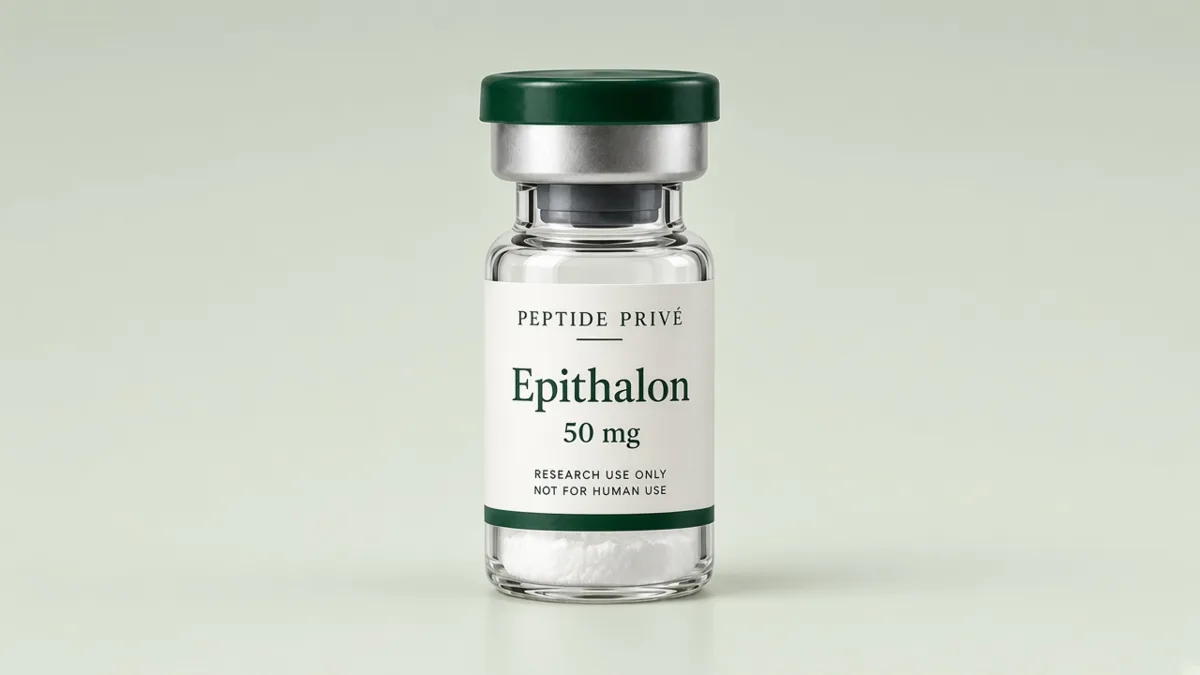
Epitalon is supplied as a lyophilized (freeze-dried) powder, usually white to off-white. Appearance alone does not confirm identity or purity.
Storage and Handling Basics
- Store sealed vials cold, dry and away from light.
- Let a cold vial reach room temperature before opening to limit condensation.
- Record the lot number and the date opened on every vial and aliquot.
- Follow your lab's own stability protocol for any solution you prepare.
Our guide on Storing Lyophilized Peptides in the Lab covers each step in more detail.
What to Check on the Analytical Report
- Lot number: it must match the lot number on your vial.
- Identity: mass spectrometry should agree with the expected mass of 390.35 g/mol for the free peptide.
- Purity: HPLC purity for the lot, with the method and detection wavelength. Four-residue acidic peptides are very polar, so check how the method retains them.
- Spelling and synonyms: make sure the report names the same compound (Epitalon, Epithalon, AEDG) as the vial.
For a field-by-field walkthrough, see How to Read a Peptide Analytical Report.
Formats We Carry
Epitalon is available as a 50 mg vial.
FAQ
Is Epitalon the same as epithalamin? No. Epithalamin is an extract of pineal tissue. Epitalon is the single synthetic tetrapeptide AEDG.
Why do so many papers share the same authors? The compound has been studied mainly by one network of laboratories. That does not make the work wrong, but independent replication is the standard way a finding gains weight. Our guide to reading retracted and corrected papers explains how to check a paper's current status.
What does AEDG stand for? The single-letter codes for alanine, glutamic acid, aspartic acid and glycine.
Sources
- Khavinson VK et al. Bulletin of Experimental Biology and Medicine, 2017. PubMed 29124531: https://pubmed.ncbi.nlm.nih.gov/29124531/
- Vanhee C et al. Drug Testing and Analysis, 2015. PubMed 25535022: https://pubmed.ncbi.nlm.nih.gov/25535022/
- Araj SK et al. International Journal of Molecular Sciences, 2025. PubMed 40141333: https://pubmed.ncbi.nlm.nih.gov/40141333/
- Al-Dulaimi S et al. Biogerontology, 2025. PubMed 40908429: https://pubmed.ncbi.nlm.nih.gov/40908429/
- Al-Dulaimi S et al. Biogerontology, 2025 (correction notice). PubMed 41240216: https://pubmed.ncbi.nlm.nih.gov/41240216/
Every Peptide Privé batch is tested by an independent lab.
Shop all peptides or contact our team with documentation questions.
For in-vitro laboratory research only. Not for human or animal use.