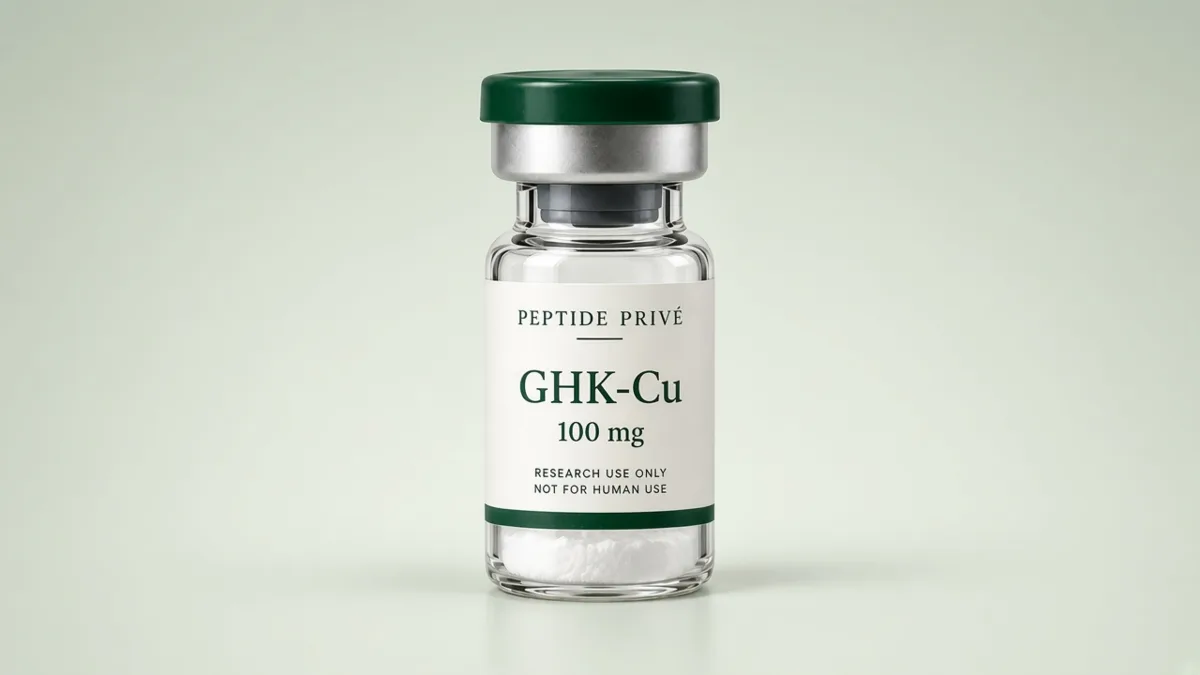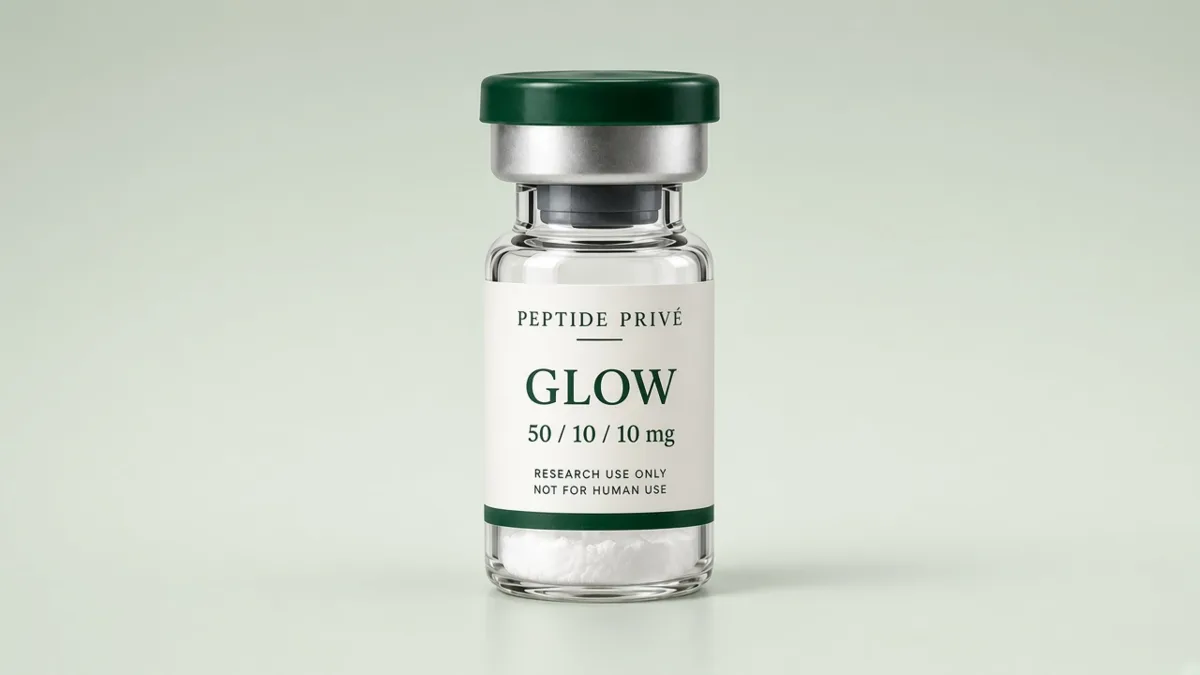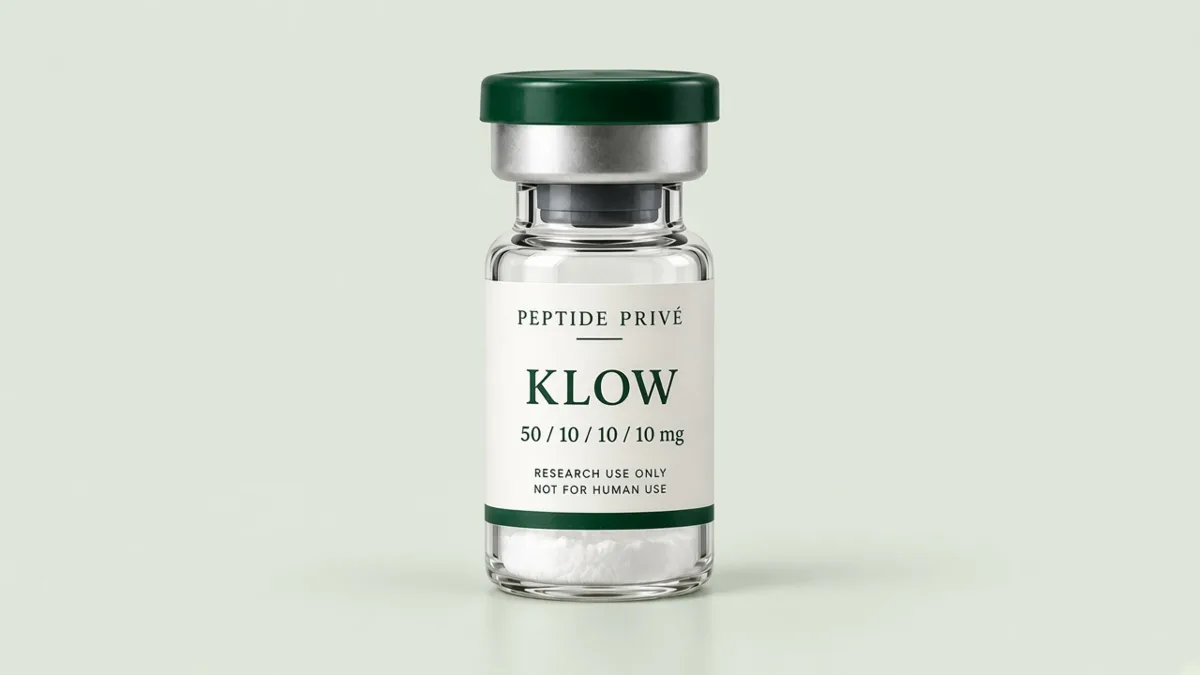
GHK-Cu is one of the smallest compounds in our catalog: three amino acids holding a single copper ion. This profile collects its identity data, its place in the published literature and the handling basics your lab needs to verify each lot.
What GHK-Cu Is
GHK is the tripeptide glycyl-L-histidyl-L-lysine (Gly-His-Lys). GHK-Cu is its complex with copper(II). The peptide and the metal are written together because the copper is bound to the peptide, not mixed in beside it.
| Property | Value |
|---|---|
| Peptide | Gly-His-Lys (GHK) |
| Bound metal | Copper(II) |
| CAS number | 49557-75-7 |
| Molecular formula | C14H22CuN6O4 |
| Molar mass | 401.91 g/mol |
How GHK Entered the Literature
GHK has a longer research history than most peptides in modern catalogs.
- 1973: Pickart and Thaler reported a small peptide factor in human serum that changed how liver cells behaved in culture.
- 1977: Schlesinger, Pickart and Thaler identified that factor as the tripeptide glycyl-histidyl-lysine.
- 1988: Maquart and colleagues reported that the copper complex, GHK-Cu, changed collagen production by fibroblasts grown in culture.
These are cell culture and animal studies. They describe what was observed in a dish or in a laboratory model, and they are the reason GHK-Cu is a common reference compound in research supply. They are not evidence of any effect in people.
Physical Form
GHK-Cu is supplied as a lyophilized (freeze-dried) powder. Because of the bound copper, the powder is typically blue to blue-violet rather than the white to off-white seen with most peptides. A blue cake is expected for this compound and is not, on its own, a sign of a problem. Identity and purity are confirmed by the analytical report, not by color.
Storage and Handling Basics
- Store sealed vials cold, dry and away from light.
- Let a cold vial reach room temperature before opening to limit condensation.
- Record the lot number and the date opened on every vial and aliquot.
- Follow your lab's own stability protocol for any solution you prepare.
Our guide on Storing Lyophilized Peptides in the Lab covers each step in more detail.
What to Check on the Analytical Report
- Lot number: it must match the lot number on your vial.
- Identity: mass spectrometry should agree with the expected mass of the complex or of the free peptide, as the report states.
- Purity: HPLC purity for the lot, with the method and detection wavelength.
- Appearance: a blue to blue-violet powder is consistent with the copper complex.
See How to Read a Peptide Analytical Report for a section-by-section walkthrough.
Formats We Carry
GHK-Cu is available as a 100 mg vial. It is also the 50 mg component of our GLOW and KLOW blends. For how a blend label maps each amount to its component, see How to Read a Multi-Peptide Blend Label.
FAQ
Why is GHK-Cu blue? The copper(II) ion bound to the peptide gives the powder its color.
Is GHK the same as GHK-Cu? No. GHK is the free tripeptide. GHK-Cu is the tripeptide bound to copper. Check which form a paper used before comparing results.
Where was GHK first found? In human serum, in work published in 1973 and identified as Gly-His-Lys in 1977.
Sources
- Pickart L, Thaler MM. Nature New Biology, 1973. PubMed 4349963: https://pubmed.ncbi.nlm.nih.gov/4349963/
- Schlesinger DH, Pickart L, Thaler MM. Experientia, 1977. PubMed 858356: https://pubmed.ncbi.nlm.nih.gov/858356/
- Maquart FX et al. FEBS Letters, 1988. PubMed 3169264: https://pubmed.ncbi.nlm.nih.gov/3169264/
Shop all peptides or contact our team with documentation questions.
For in-vitro laboratory research only. Not for human or animal use.