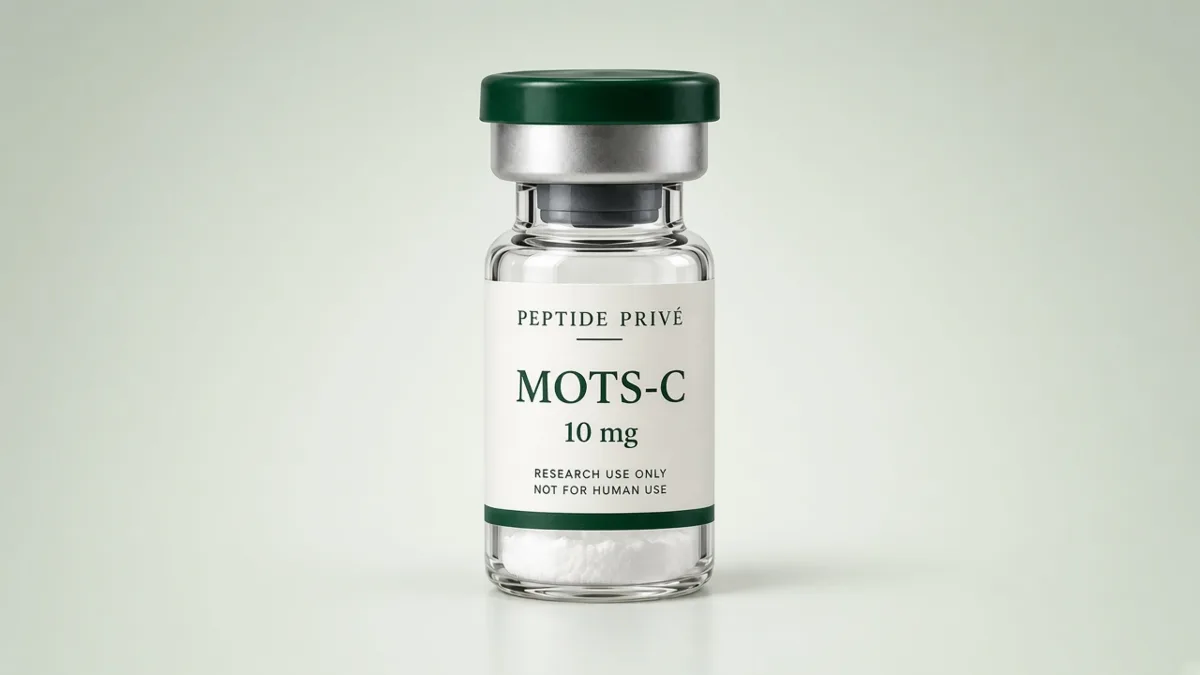
Almost every peptide in a catalog is encoded in the cell nucleus. MOTS-c is different: its sequence is read from the small genome inside mitochondria. This profile covers how it was found, what laboratory studies have looked at, and the data your lab needs to verify each lot.
A Peptide Encoded in Mitochondrial DNA
Mitochondria carry their own compact genome, a remnant of their bacterial ancestry. For a long time that genome was thought to encode only a fixed set of components for the mitochondrion's own machinery.
That picture changed when researchers began finding short open reading frames (sORFs) inside mitochondrial DNA that encode small peptides. Peptides from this source are grouped as mitochondrial-derived peptides. Humanin was described earlier; MOTS-c followed.
Discovery and Name
In 2015, Lee and colleagues reported a short open reading frame within the gene for the mitochondrial 12S ribosomal RNA. It encodes a 16-amino-acid peptide. The name is an acronym of its location: Mitochondrial Open reading frame of the Twelve S rRNA, type c.
Chemical Identity
| Property | Value |
|---|---|
| Length | 16 amino acids |
| Sequence | Met-Arg-Trp-Gln-Glu-Met-Gly-Tyr-Ile-Phe-Tyr-Pro-Arg-Lys-Leu-Arg (MRWQEMGYIFYPRKLR) |
| CAS number | 1627580-64-6 |
| Molecular formula | C101H152N28O22S2 |
| Molar mass | 2174.6 g/mol |
Formula and molar mass agree with the PubChem record for MOTS-c.
What Cell and Mouse Studies Have Examined
The published work on MOTS-c is preclinical. A few studies show the questions researchers have asked:
Signalling inside the cell
The 2015 discovery paper reported that, in cultured cells, MOTS-c acted on the folate cycle and linked purine synthesis, which led to activation of AMPK (AMP-activated protein kinase), a widely studied cellular signalling enzyme.
Travel from mitochondria to the nucleus
A 2018 study by Kim and colleagues reported that, in cultured cells placed under stress, MOTS-c moved into the nucleus in an AMPK-dependent manner. There it was associated with changes in the expression of a range of nuclear genes, including genes with antioxidant response elements. The authors described this as evidence that the mitochondrial genome can encode factors that act on the nuclear genome.
Mitochondrial efficiency in mice
A 2026 study by Gudiksen and colleagues used two genetically modified mouse strains. It reported changes in mitochondrial efficiency and lower release of reactive oxygen species that depended on both AMPK and the coactivator PGC-1α. The authors noted these changes occurred without an apparent change in the amount of mitochondrial respiratory protein, pointing to changes within existing mitochondria rather than more of them.
These are cell and animal experiments under specific laboratory conditions. They are not evidence of any effect in people, and we make no such claims. For how to weigh different study models, see Dish, Mouse or Human? Reading the Model Behind a Peptide Study.
Physical Form, Storage and Handling
MOTS-c is supplied as a lyophilized powder.
- Store sealed vials cold, dry and away from light.
- Let a cold vial reach room temperature before opening.
- Record the lot number and date opened on every vial and aliquot.
See Storing Lyophilized Peptides in the Lab.
What to Check on the Analytical Report
- Lot number matches the vial.
- Identity: mass spectrometry should agree with the expected 2174.6 g/mol.
- Purity: HPLC result, with method and wavelength.
At 16 residues, MOTS-c is longer than most catalog peptides, so a clean single main peak on the chromatogram is worth checking. See How to Read a Peptide Analytical Report.
FAQ
What does MOTS-c stand for? Mitochondrial open reading frame of the 12S rRNA, type c.
Is MOTS-c made in the nucleus? No. Its coding sequence lies in mitochondrial DNA, which is what makes it unusual.
Which formats do you carry? MOTS-c is available as 10 mg and 40 mg vials.
Sources
- Lee C et al. Cell Metabolism, 2015. PubMed 25738459: https://pubmed.ncbi.nlm.nih.gov/25738459/
- Kim KH, Son JM, Benayoun BA, Lee C. Cell Metabolism, 2018. PubMed 29983246: https://pubmed.ncbi.nlm.nih.gov/29983246/
- Gudiksen A et al. Free Radical Biology and Medicine, 2026. PubMed 41520850: https://pubmed.ncbi.nlm.nih.gov/41520850/
- PubChem compound record: https://pubchem.ncbi.nlm.nih.gov/compound/146675088
Shop all peptides or contact our team with documentation questions.
For in-vitro laboratory research only. Not for human or animal use.