SS-31 is a small synthetic peptide built to accumulate at one place in the cell: the inner mitochondrial membrane. That design makes it a useful tool compound for membrane biochemistry, and it also means the literature around it is unusually concentrated in a few laboratories. This profile covers what the compound is, what the mechanism studies show and what a lab should verify.
What SS-31 Is
SS-31, also called elamipretide, belongs to the Szeto-Schiller (SS) peptides, a family of short peptides whose structure alternates aromatic and positively charged (cationic) residues. In the 2006 overview by Szeto, the defining motif is a repeating alternation of aromatic residues and basic residues, with the aromatic side including a tyrosine or dimethyltyrosine residue. Mitchell and colleagues (2020, 2022) describe the class as amphipathic tetrapeptides, meaning four residues with both charged and oily surfaces.
| Property | Value |
|---|---|
| Class | Szeto-Schiller aromatic-cationic tetrapeptide |
| Also called | Elamipretide |
| CAS number | 736992-21-5 |
| Molecular formula | C32H49N9O5 |
| Molar mass | 639.8 g/mol |
Because it includes non-standard residues, SS-31 does not read as a plain string of the 20 standard amino acid letters. When a report or paper gives a sequence, check how it writes the dimethyltyrosine and the stereochemistry.
What Cell, Animal and Biophysical Studies Have Examined
- Where it goes. Szeto's 2006 overview reports that SS peptides concentrate more than 1000-fold in the inner mitochondrial membrane in cell experiments, and that their reported antioxidant behavior is attributed to the tyrosine or dimethyltyrosine residue.
- Cardiolipin binding. Birk and colleagues (2013) used a fluorescent analog of SS-31 to show high-affinity binding to cardiolipin, an anionic phospholipid enriched in the inner mitochondrial membrane. In a rat renal ischemia model, they reported preserved mitochondrial cristae structure.
- Surface electrostatics. Mitchell and colleagues (2020) used biophysical and computational methods and reported that SS-31 sits at the membrane interface, binds in proportion to surface charge, does not destabilize the bilayer, and changes surface electrostatics and calcium distribution in model membranes.
- Structure and analogs. Mitchell and colleagues (2022) compared SS-31 against three tetrapeptide analogs and presented the first structural models for the class, based on NMR and molecular dynamics. A 2025 review by Tung and colleagues summarizes the structure and proposed mechanism in one place.
These are cell culture, biophysical and animal-model studies. They describe how the peptide behaves with membranes in a dish or a laboratory model. They are not evidence of any effect in people.
A Note on Conflicts of Interest
The conflict-of-interest statement in the 2020 paper names one of its authors as the inventor of this peptide class and a founder of the company that licensed the technology. That is normal for a compound developed in one place, and it is disclosed. It does mean that independent replication outside the originating group deserves extra weight when you can find it. Our guide to reading the model behind a study covers what to look for.
Physical Form
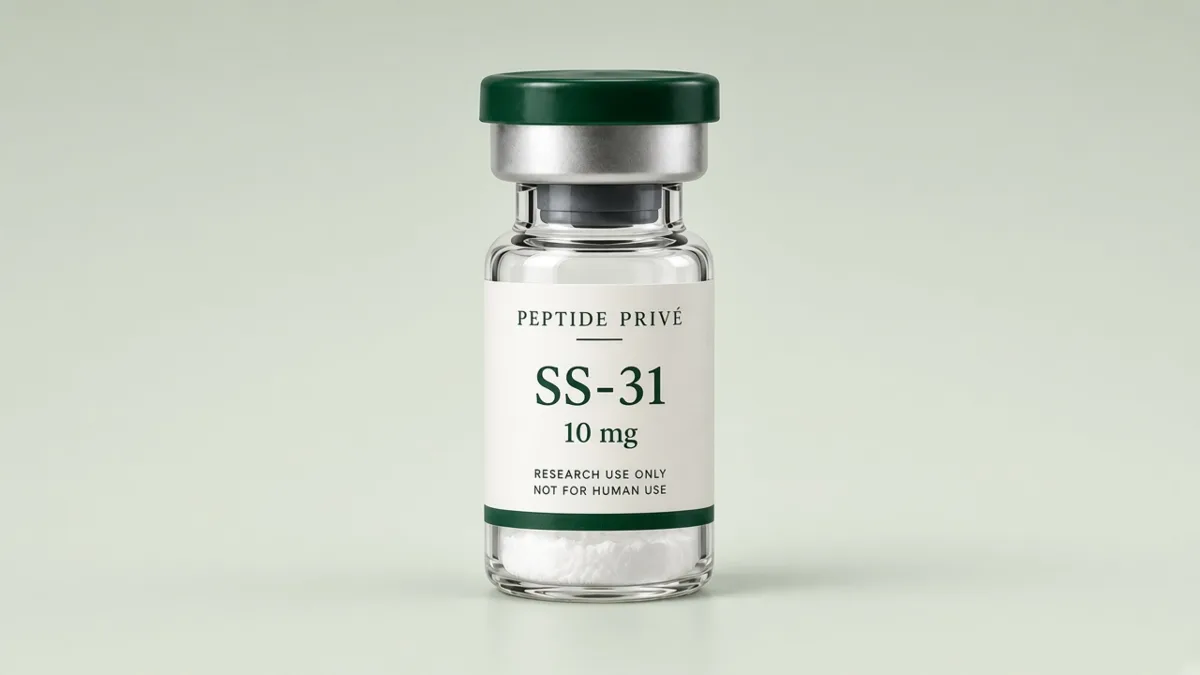
SS-31 is supplied as a lyophilized (freeze-dried) powder, usually white to off-white. Appearance alone does not confirm identity or purity.
Storage and Handling Basics
- Store sealed vials cold, dry and away from light.
- Let a cold vial reach room temperature before opening to limit condensation.
- Record the lot number and the date opened on every vial and aliquot.
- Follow your lab's own stability protocol for any solution you prepare.
Because the peptide binds to charged surfaces, ask your lab about adsorption to glass and plastic when you prepare dilute solutions. Our guide on Storing Lyophilized Peptides in the Lab covers the basics.
What to Check on the Analytical Report
- Lot number: it must match the lot number on your vial.
- Identity: mass spectrometry should agree with the expected mass of about 639.8 g/mol.
- Purity: HPLC purity for the lot, with the method and detection wavelength.
- Structure details: because the molecule includes non-standard residues, confirm that the report identifies the compound unambiguously (name, CAS and mass), not only a short sequence string.
For a field-by-field walkthrough, see How to Read a Peptide Analytical Report.
Formats We Carry
SS-31 is available as a 10 mg vial.
FAQ
Is SS-31 the same as elamipretide? They are the same compound described under two names: a laboratory code and a nonproprietary name.
Why is it called a "mitochondria-targeted" peptide? Because in cell experiments the peptide concentrates in the inner mitochondrial membrane, where it interacts with cardiolipin.
Why check the mass if the label gives a name? A name does not show whether the correct residues, in the correct stereochemistry, were made. The mass and chromatogram do.
Sources
- Szeto HH. AAPS Journal, 2006. PubMed 16796378: https://pubmed.ncbi.nlm.nih.gov/16796378/
- Birk AV et al. Journal of the American Society of Nephrology, 2013. PubMed 23813215: https://pubmed.ncbi.nlm.nih.gov/23813215/
- Mitchell W et al. Journal of Biological Chemistry, 2020. PubMed 32273339: https://pubmed.ncbi.nlm.nih.gov/32273339/
- Mitchell W et al. eLife, 2022. PubMed 35913044: https://pubmed.ncbi.nlm.nih.gov/35913044/
- Tung C et al. International Journal of Molecular Sciences, 2025. PubMed 39940712: https://pubmed.ncbi.nlm.nih.gov/39940712/
Every Peptide Privé batch is tested by an independent lab.
Shop all peptides or contact our team with documentation questions.
For in-vitro laboratory research only. Not for human or animal use.