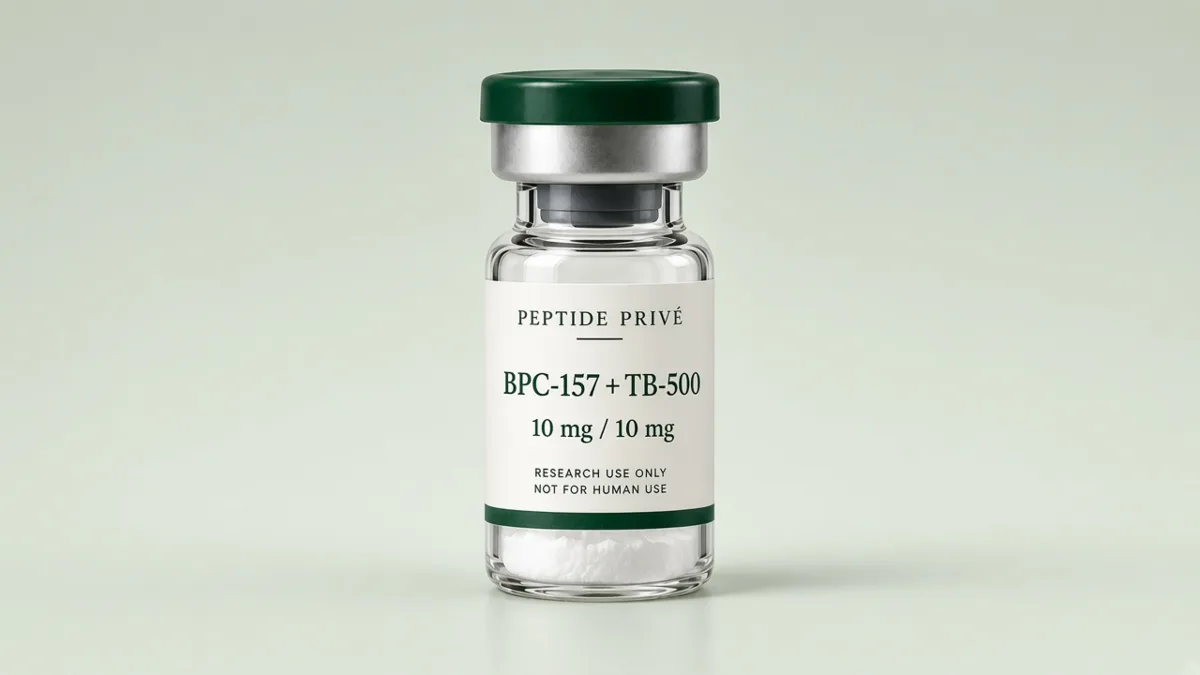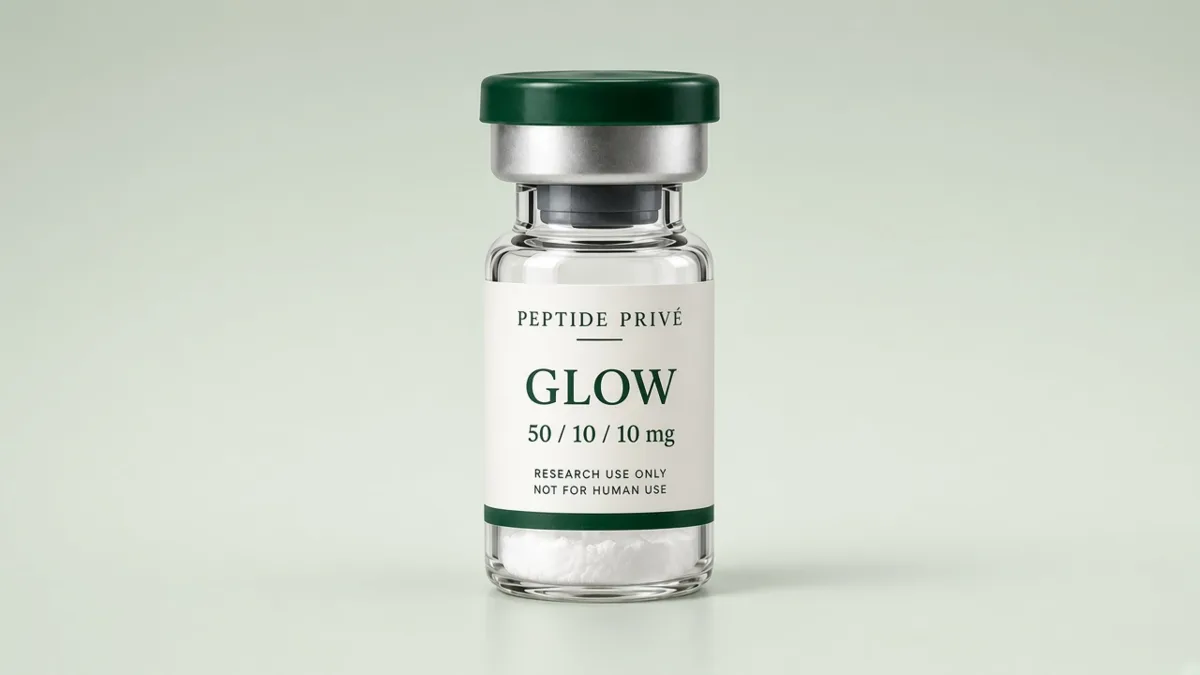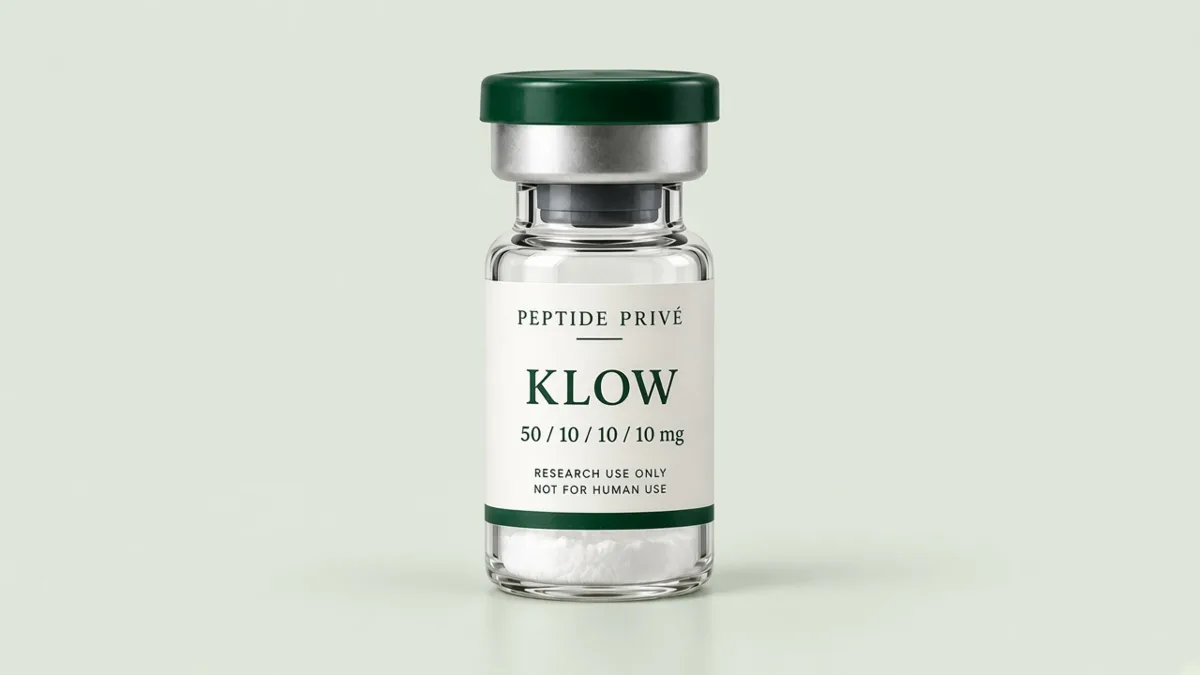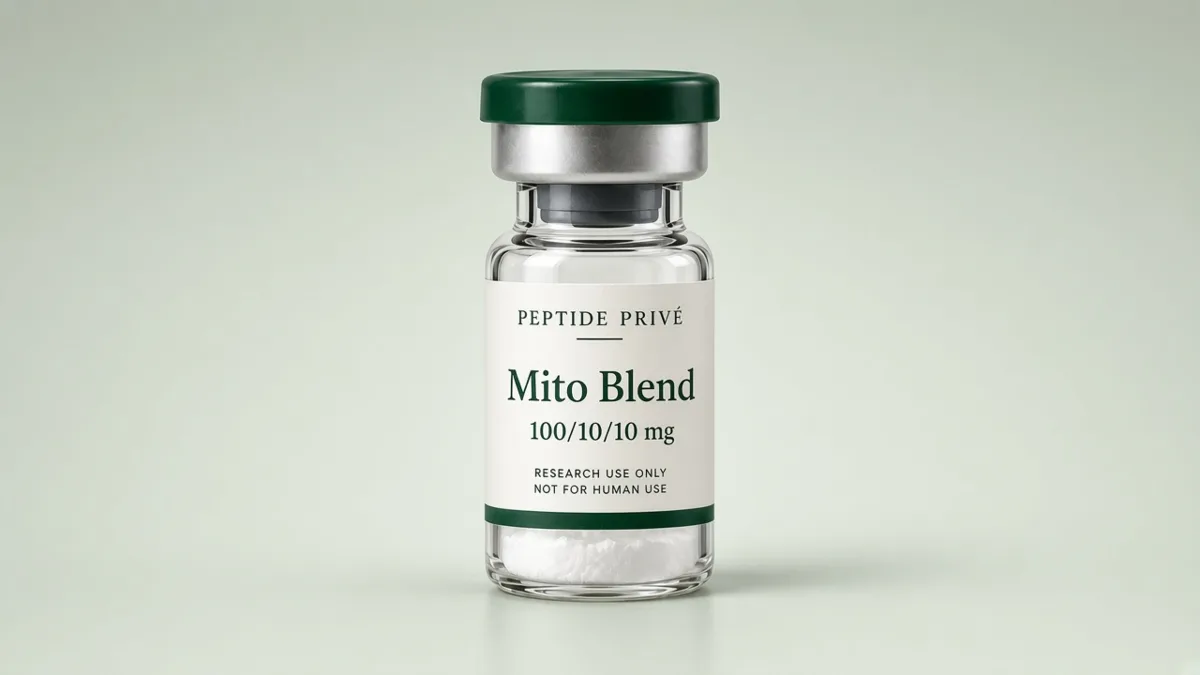
A multi-peptide blend puts two or more compounds in the same vial. From a chemistry point of view, that is not the same as having two separate vials. Each component brings its own amino acids, counter-ions and, sometimes, metal ions. Once they share a container, they share an environment: the same residual moisture, the same headspace oxygen, the same pH once dissolved, and the same light and temperature history.
This guide explains, in general terms and from published stability literature, the main ways components in a blend can interact. It does not make claims about any specific product. It is meant to help researchers ask better questions of a blend and its documentation. For how to read the label itself, start with How to Read a Multi-Peptide Blend Label.
Why a Blend Is a Chemistry Question
Peptide degradation is usually described in two families. A 2023 review of peptide formulation stability in Pharmaceutics summarises them:
- Chemical instability creates or breaks covalent bonds and produces new chemical entities. Examples include oxidation, hydrolysis, β-elimination, deamidation, racemisation, isomerisation and disulfide exchange.
- Physical instability changes non-covalent structure without breaking covalent bonds. Examples include changes in secondary structure, adsorption to surfaces, aggregation and precipitation.
The same review tabulates which residues and conditions are involved. Oxidation involves Trp, Met, Cys, Tyr and His and is influenced by pH, temperature and oxygen. Deamidation involves Asn and Gln. Disulfide exchange involves Cys-Cys bonds and is influenced by pH, oxygen and metal ions.
In a single-peptide vial, those pathways depend on that peptide's own sequence. In a blend, one component can supply the trigger and another the target. That is the core idea of this guide.
Interaction 1: Metal-Catalysed Oxidation
The Pharmaceutics review lists metal-induced oxidation, catalysed by metal ions such as copper and iron, as a degradation pathway involving His, Cys, Arg, Pro and Met. It explains that metal-catalysed oxidation needs redox-active metal ions, generates reactive oxygen species, and damages residues such as His, Cys and Met.
The review makes an important point about where this damage happens. Metal-catalysed oxidation is frequently site-specific, driven by transition metals bound at metal-binding sites. So it often does not target the most solvent-exposed residues. It targets residues that are part of, or close to, the metal-binding site.
Why this matters for blends
Some research peptides are supplied as metal complexes. The best-known example is the copper complex of the tripeptide GHK, described in our GHK-Cu compound profile. When a copper-containing component shares a vial with a peptide that contains Met, Cys or His, the literature gives reason to ask:
- Is any free or loosely bound copper available to catalyse oxidation of the other component?
- Has the blend been tested for oxidised forms of the other component, for example by mass spectrometry, where Met oxidation adds +16 Da?
- Does the stability information for the blend cover the combination, or only each component on its own?
None of this means such a combination is unstable. It means the question is legitimate and is answered by data on the blend, not by data on each component separately.
Interaction 2: Thiol-Disulfide Exchange
Cysteine is chemically special. Its side chain is a thiol (-SH), and two cysteines can form a disulfide (-S-S-) bond. A review by Trivedi, Laurence and Siahaan in Current Protein & Peptide Science (2009) describes how disulfide bonds can be attacked under neutral and basic conditions. The resulting thiolate anion can attack a disulfide bond on another molecule, producing dimers and higher oligomers through intermolecular disulfide bonds. The Pharmaceutics review lists disulfide exchange as dependent on pH, oxygen and metal ions.
In a blend, this means:
- A component with a free thiol and a component with a disulfide bond can, in principle, exchange partners. The result is mixed disulfides that are neither original molecule.
- Two thiol-containing components can cross-link through a new disulfide.
- The products may show up as new peaks in HPLC and new masses in mass spectrometry, not as a simple loss of one component.
It can happen in the dry state too
A common assumption is that freeze-dried powders are chemically frozen. A study by Chandrasekhar and Topp (Journal of Pharmaceutical Sciences, 2015) used peptides derived from human growth hormone to study thiol-disulfide exchange during lyophilisation and during storage of the dried powders. They report that covalent changes such as thiol-disulfide exchange and disulfide scrambling can occur even in the solid state. In their system, native disulfide was lost during primary drying and regenerated during secondary drying, and reactions continued during storage of the powder.
The lesson for blends is modest but real. Dry storage greatly slows chemistry, but it does not make it impossible. That is why storage conditions matter. See Storing Lyophilized Peptides and Why Peptides Ship as a Dry Powder.
Interaction 3: A Shared Environment
Some interactions are not between components at all. They come from the fact that the components now live under one set of conditions.
One pH for everyone
Once a blend is dissolved for an experiment, all components sit at the same pH. The Pharmaceutics review shows that hydrolysis, deamidation, oxidation and disulfide exchange all depend on pH. A pH that suits one component may speed degradation of another. A blend's documentation cannot pick the best pH for each component separately.
One solvent for everyone
Dissolution guidance for single peptides does not always transfer to blends. ProImmune's peptide handling guide, for example, advises avoiding DMSO for peptides that contain methionine, cysteine or tryptophan because of sulfoxide or disulfide formation. In a blend, the most sensitive component sets the limits on the solvent.
Counter-ions and excipients
Each component may carry counter-ions from synthesis and purification, such as acetate or trifluoroacetate. In a blend, these combine. That affects the net peptide content of each component and the pH of the dissolved mixture. See Net Peptide Content vs. HPLC Purity.
Surfaces and aggregation
Physical instability, including adsorption to container surfaces and aggregation, depends on concentration and conditions. The Pharmaceutics review lists adsorption (involving residues such as His and Arg) and aggregation (influenced by concentration and pH) among the physical pathways. Mixing components changes the total peptide concentration and the mix of surface-active molecules in the vial.
Why Analysing a Blend Is Harder
Analysing a single peptide by reversed-phase HPLC means separating one main peak from its related impurities. A blend has several main peaks, each with its own impurity profile. Several things follow:
- Co-elution. An impurity of one component can elute at the same retention time as another component, or as an impurity of another component. A clean-looking chromatogram is only as good as the method's ability to separate everything. See Is the Test Method Fit for Purpose? for why specificity is the first characteristic method validation looks at.
- Purity per component vs. purity of the blend. "Purity" can mean the share of each component's own peak among related species, or the combined main peaks as a share of all peaks. These are different numbers. Look for how purity is defined.
- Identity for each component. Mass spectrometry should show the expected mass of every component, plus any new species such as mixed disulfides or oxidised forms.
- Quantity of each component. The amount of each component in the vial is a separate measurement from purity.
Our guides on How to Read a Peptide Analytical Report and Peptide-Related Impurities Explained cover these ideas for single peptides. All of them apply to blends, multiplied by the number of components.
Questions Worth Asking About a Blend
- What residues are present? List any Cys, Met, Trp, His, Asn and Gln in each component, since these are the usual sites of chemical degradation.
- Is any component a metal complex? If so, consider metal-catalysed oxidation of the others.
- Do any components have free thiols or disulfides? If so, consider exchange and cross-linking.
- Does the analytical documentation cover the blend as a whole, with a method shown to separate all components and their impurities?
- Does stability information cover the combination, or only each component on its own?
- What are the storage conditions, and do they suit the most sensitive component?
FAQ
Does a blend degrade faster than its components separately? Not necessarily. It depends on the components and conditions. The point is that the answer comes from data on the blend.
Can I predict interactions from the sequences? Sequences tell you which pathways are possible, such as oxidation at Met or exchange at Cys. Whether those pathways matter in practice depends on conditions and must be measured.
Is a blend's HPLC purity comparable to a single peptide's? Only if purity is defined the same way. Check whether it is reported per component or for the whole mixture.
Sources
- Nugrahadi PP, Hinrichs WLJ, Frijlink HW, et al. Designing Formulation Strategies for Enhanced Stability of Therapeutic Peptides in Aqueous Solutions: A Review. Pharmaceutics. 2023;15(3):935. https://pmc.ncbi.nlm.nih.gov/articles/PMC10056213/
- Trivedi MV, Laurence JS, Siahaan TJ. The role of thiols and disulfides in protein chemical and physical stability. Curr Protein Pept Sci. 2009;10(6):614-625. https://pmc.ncbi.nlm.nih.gov/articles/PMC3319691/
- Chandrasekhar S, Topp EM. Thiol-disulfide exchange in peptides derived from human growth hormone during lyophilization and storage in the solid state. J Pharm Sci. 2015;104(4):1291-1302. https://pmc.ncbi.nlm.nih.gov/articles/PMC4359671/
- ProImmune. Working with Peptides (technical guide): https://www.proimmune.com/wp-content/uploads/2021/08/ST55.pdf
Every Peptide Privé batch is tested by an independent lab.
Contact our team with documentation questions.
For in-vitro laboratory research only. Not for human or animal use.