KPV is among the shortest peptides a lab can buy: three residues, one backbone, no ring or metal. Its short length makes the identity data simple, and its history is tied to a much larger hormone. This profile collects what the published literature says about it and what to verify on each lot.
What KPV Is
KPV is the tripeptide lysyl-prolyl-valine (Lys-Pro-Val). It matches the last three residues at the C-terminal end of α-melanocyte-stimulating hormone (α-MSH), a 13-residue peptide made from the pro-opiomelanocortin precursor. In older papers it is written α-MSH(11–13), which names the same three positions.
| Property | Value |
|---|---|
| Sequence | Lys-Pro-Val |
| Parent peptide | α-MSH, residues 11–13 |
| CAS number | 67727-97-3 |
| Molecular formula | C16H30N4O4 |
| Molar mass | 342.43 g/mol |
How KPV Entered the Literature
KPV was first studied as a piece of a larger molecule, not as a compound in its own right.
- 1989: Hiltz and Lipton, working in mice, reported that the C-terminal tripeptide of α-MSH reduced a skin-swelling response in an ear-swelling model. The authors framed it as a possible active region of the parent hormone.
- 2000s: Groups studying α-MSH related peptides reviewed how the hormone and its fragments change inflammatory signaling in immune cells. Luger and colleagues' 2007 review is a typical summary.
- 2008: Two papers examined KPV in mouse colitis models. Dalmasso and colleagues reported that KPV entered intestinal and immune cells through the PepT1 peptide transporter and lowered NF-κB and MAP kinase signaling readouts in cultured cells. Kannengiesser and colleagues reported results from two mouse colitis models, including mice that lack a working melanocortin-1 receptor, and concluded that part of the effect did not depend on that receptor.
All of this is cell culture and animal work. It describes what was observed in a dish or in a laboratory model, and it is why KPV appears in inflammation-signaling research. It is not evidence of any effect in people.
What Cell and Animal Studies Have Examined
- Uptake route. PepT1 is a transporter for di- and tripeptides. The 2008 Gastroenterology paper used it to explain how a very small peptide could get inside cells.
- Signaling readouts. The reported readouts were NF-κB reporter activity, MAP kinase phosphorylation and cytokine secretion in cultured cells.
- Receptor dependence. The mouse colitis work suggests the effects are at least partly separate from the main melanocortin receptor, which is why KPV is not simply used as a stand-in for the whole hormone.
- Delivery formats. Later work, such as Xiao and colleagues in 2017, loaded KPV into hyaluronic acid nanoparticles for a colitis model, which shows one way researchers have approached delivery of such a short peptide.
When you compare papers, check which species, which cell line and which model each one used. Results from a colitis model should not be carried into a different system without that system's own data.
Physical Form
KPV is supplied as a lyophilized (freeze-dried) powder, usually white to off-white. The colour of the cake alone does not confirm identity or purity; the analytical report does.
Storage and Handling Basics
- Store sealed vials cold, dry and away from light.
- Let a cold vial reach room temperature before opening to limit condensation.
- Record the lot number and the date opened on every vial and aliquot.
- Follow your lab's own stability protocol for any solution you prepare.
Our guide on Storing Lyophilized Peptides in the Lab covers each step in more detail.
What to Check on the Analytical Report
- Lot number: it must match the lot number on your vial.
- Identity: mass spectrometry should agree with the expected mass of 342.43 g/mol for the free peptide.
- Purity: HPLC purity for the lot, with the method and detection wavelength. A tripeptide this small and polar elutes early, so look at how the method handles the solvent front.
- Counter-ion and water: report fields for these explain why the weight of powder in a vial is not the same as the weight of peptide.
For a field-by-field walkthrough, see How to Read a Peptide Analytical Report.
Formats We Carry
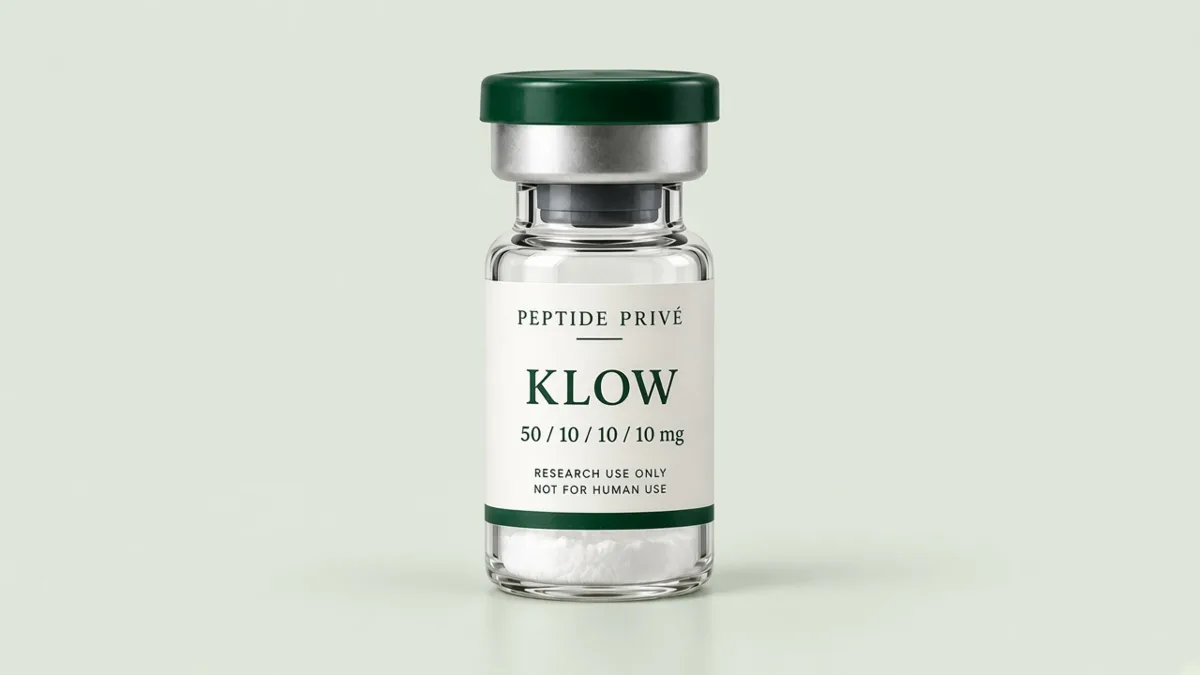
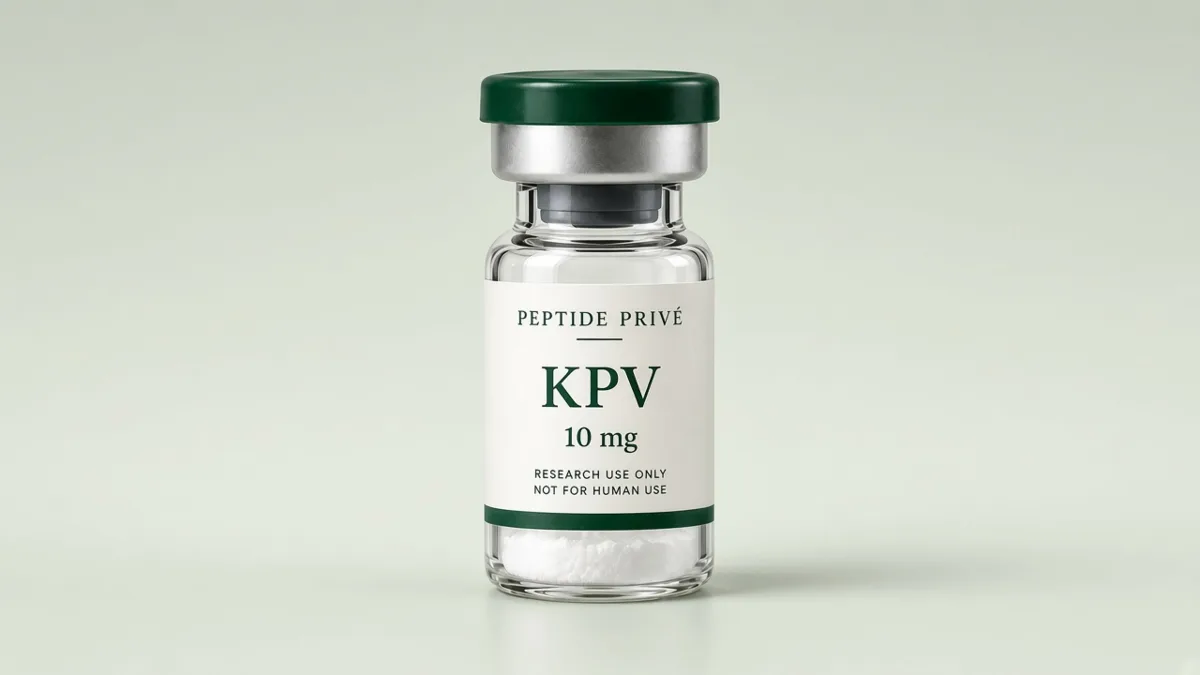
KPV is available as a 10 mg vial. It is also the 10 mg KPV component of our KLOW blend. For how a blend label maps each amount to its component, see How to Read a Multi-Peptide Blend Label.
FAQ
Is KPV the same as α-MSH? No. α-MSH has 13 residues. KPV is only its last three. Papers on the full hormone should not be read as papers on KPV.
Why is KPV described as a fragment? Because it was identified by taking the hormone apart and testing the pieces, not found as a separate natural product.
Does a short peptide still need a mass check? Yes. A small peptide can carry deletion or racemized impurities that look similar on a chromatogram. Mass and purity data together are what the report is for.
Sources
- Hiltz ME, Lipton JM. FASEB Journal, 1989. PubMed 2550304: https://pubmed.ncbi.nlm.nih.gov/2550304/
- Luger TA, Brzoska T. Annals of the Rheumatic Diseases, 2007. PubMed 17934097: https://pubmed.ncbi.nlm.nih.gov/17934097/
- Dalmasso G et al. Gastroenterology, 2008. PubMed 18061177: https://pubmed.ncbi.nlm.nih.gov/18061177/
- Kannengiesser K et al. Inflammatory Bowel Diseases, 2008. PubMed 18092346: https://pubmed.ncbi.nlm.nih.gov/18092346/
- Xiao B et al. Mol Ther, 2017. PubMed 28143741: https://pubmed.ncbi.nlm.nih.gov/28143741/
Every Peptide Privé batch is tested by an independent lab.
Shop all peptides or contact our team with documentation questions.
For in-vitro laboratory research only. Not for human or animal use.