"TB-500" is one of the most searched peptide names, and one of the least consistent. Some sources use it for the full thymosin β4 protein. Others, including the published doping-control literature, use it for a short piece of that protein. For a lab, that difference decides what the vial should contain and what the mass spectrum should show.
What Thymosin Beta-4 Is
Thymosin β4 (Tβ4) is a 43-residue peptide found in nearly all cell types. Its best-characterized biochemical role is binding monomeric actin. Hannappel's 2007 review recounts that Safer and colleagues recognized the G-actin-sequestering activity in 1990, and describes the β-thymosins as the main intracellular G-actin-sequestering peptides in most vertebrate cells. The review also notes that Tβ4 is unstructured on its own and folds into a stable conformation only when it binds actin.
It was first isolated from thymosin fraction 5, a crude thymus-derived mixture of polypeptides. Hannappel's review notes that none of the peptides isolated from that fraction turned out to be thymic hormones in the strict sense; they are widely distributed peptides with other functions.
What "TB-500" Means in the Literature
Two papers published in 2012 are the clearest record of what products sold as TB-500 contained.
- Esposito and colleagues (Ghent University, 2012) analyzed a product sold as TB-500 by high-resolution mass spectrometry and identified the N-terminal acetylated 17–23 fragment of thymosin β4, Ac-LKKTETQ.
- Ho and colleagues (Hong Kong, 2012) described TB-500 as a veterinary preparation whose key ingredient is the peptide LKKTETQ with an artificially acetylated N-terminus, and built a mass spectrometry method to detect it and its metabolites in equine samples.
A 2025 paper from French doping-control laboratories (Delcourt and colleagues) added that online products may claim to contain either an acetylated Tβ4 fragment or Tβ4 itself, and reported that a non-natural synthesis impurity could be detected in equine plasma, which is one way analysts distinguish a synthetic product from the natural protein.
In plain terms: in the analytical literature, "TB-500" is a seven-residue acetylated fragment of about 0.9 kDa (our own calculation from the sequence), not the 43-residue protein of about 4.96 kDa.
| Item | Thymosin β4 | Ac-LKKTETQ ("TB-500" in the 2012 papers) |
|---|---|---|
| Length | 43 residues | 7 residues |
| Sequence | SDKPDMAEIEKFDKSKLKKTETQEKNPLPSKETIEQEKQAGES (UniProt P62328; N-terminal acetyl not shown) | LKKTETQ with an acetylated N-terminus |
| Position in Tβ4 | whole protein | residues 17–23 |
| Approximate mass | about 4.96 kDa | about 0.89 kDa (calculated) |
| Role described | actin-sequestering protein | the actin-binding region of Tβ4 |
Why This Matters at the Bench
Mass is the quickest way to tell the two apart. Our catalog lists TB-500 under CAS 77591-33-4 with a molar mass of 4963.44 g/mol, which corresponds to the full 43-residue thymosin β4 rather than the 0.89 kDa fragment. When you read a paper that says "TB-500", check which molecule its authors actually used before comparing results with a vial of either one. A mass spectrum on the report that matches the stated molar mass is the check that settles it.
What Cell and Animal Studies Have Examined
- Actin biology. Thymosin β4 regulates the pool of unpolymerized actin. This is the foundation most later work builds on.
- Active regions. Sosne and colleagues (2010) reviewed how short sequences within Tβ4, including the LKKTETQ actin-binding region and an N-terminal Ac-SDKP motif, have been linked to separate cell activities in culture and animal models.
- Wound models. Malinda and colleagues (1999) reported results from a rat full-thickness wound model and a keratinocyte migration assay; this is among the early papers behind the interest in Tβ4.
These are cell culture and animal studies. A human safety and pharmacokinetics study of synthetic thymosin β4 in healthy volunteers has also been published (Ruff and colleagues, 2010). It is listed here only as published research; it says nothing about what a research-grade vial does.
Physical Form and Storage
Both forms are supplied as lyophilized powders. Store sealed vials cold, dry and away from light, let a cold vial reach room temperature before opening, and record the lot and date opened on every vial. See Storing Lyophilized Peptides in the Lab.
What to Check on the Analytical Report
- Lot number: it must match the vial.
- Identity: the observed mass should match the molecule the label names. For the full protein, expect a mass near 4.96 kDa; for Ac-LKKTETQ, near 0.89 kDa.
- Purity: HPLC purity with the method, wavelength and integration notes. A 43-residue peptide is far more likely to show side peaks than a short one.
- Modifications: confirm whether the report states N-terminal acetylation, since both the natural protein and the fragment in the literature are acetylated.
See How to Read a Peptide Analytical Report for the walkthrough.
Formats We Carry
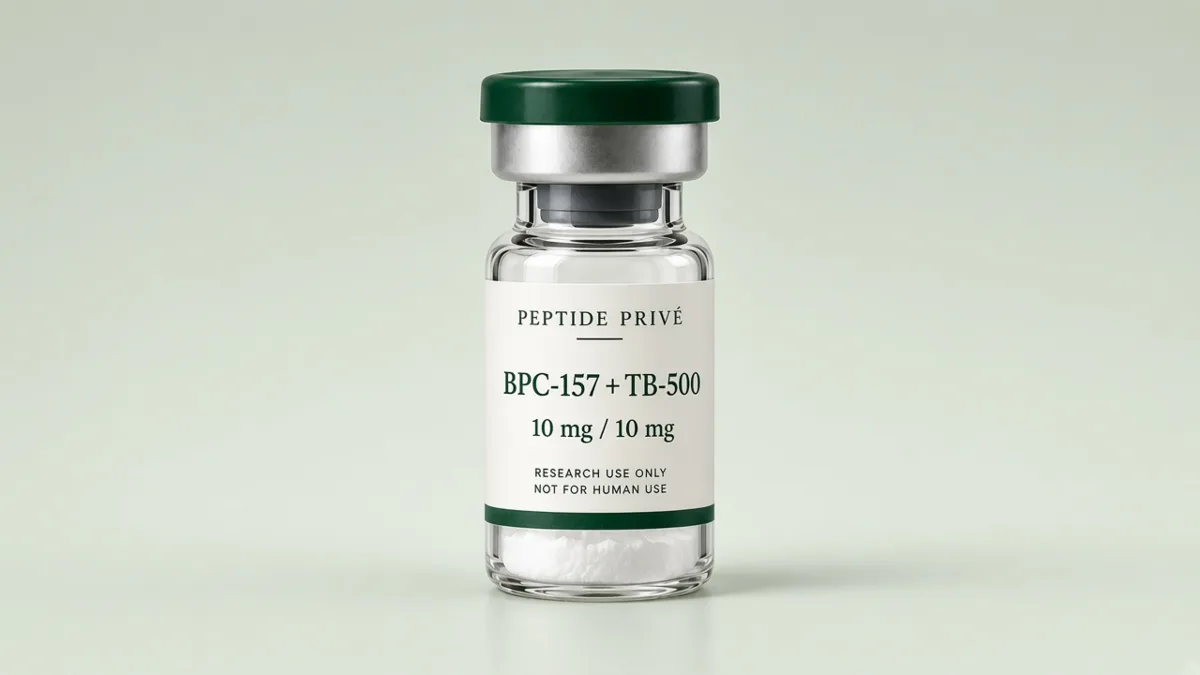
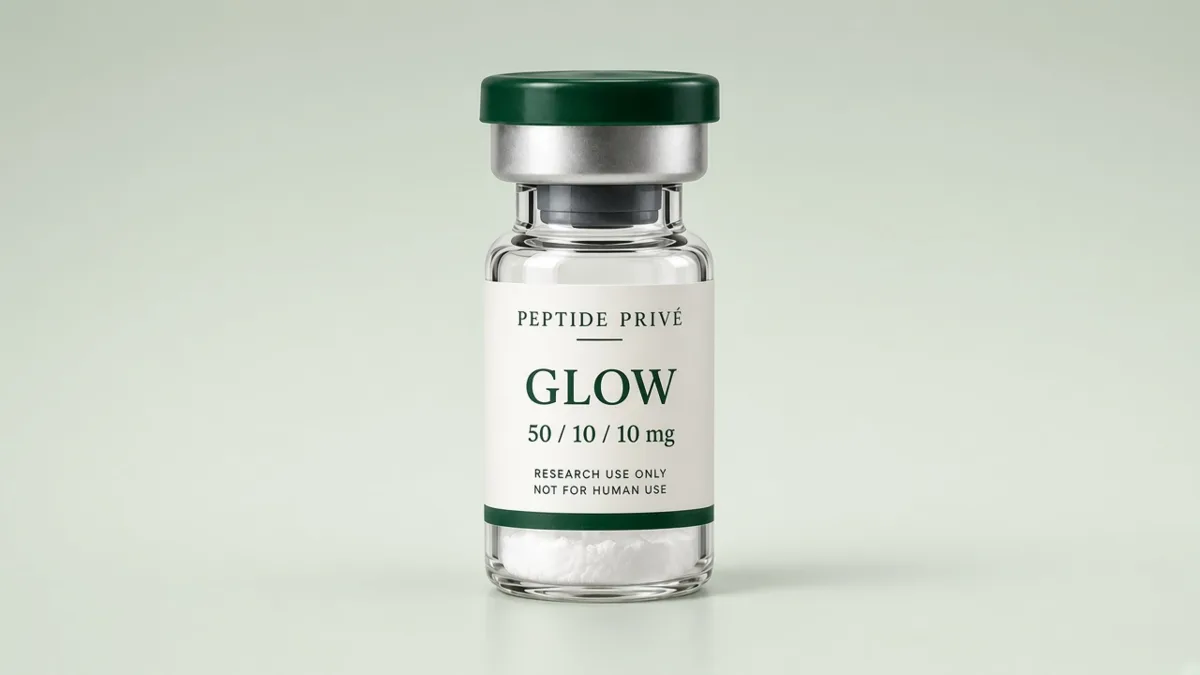
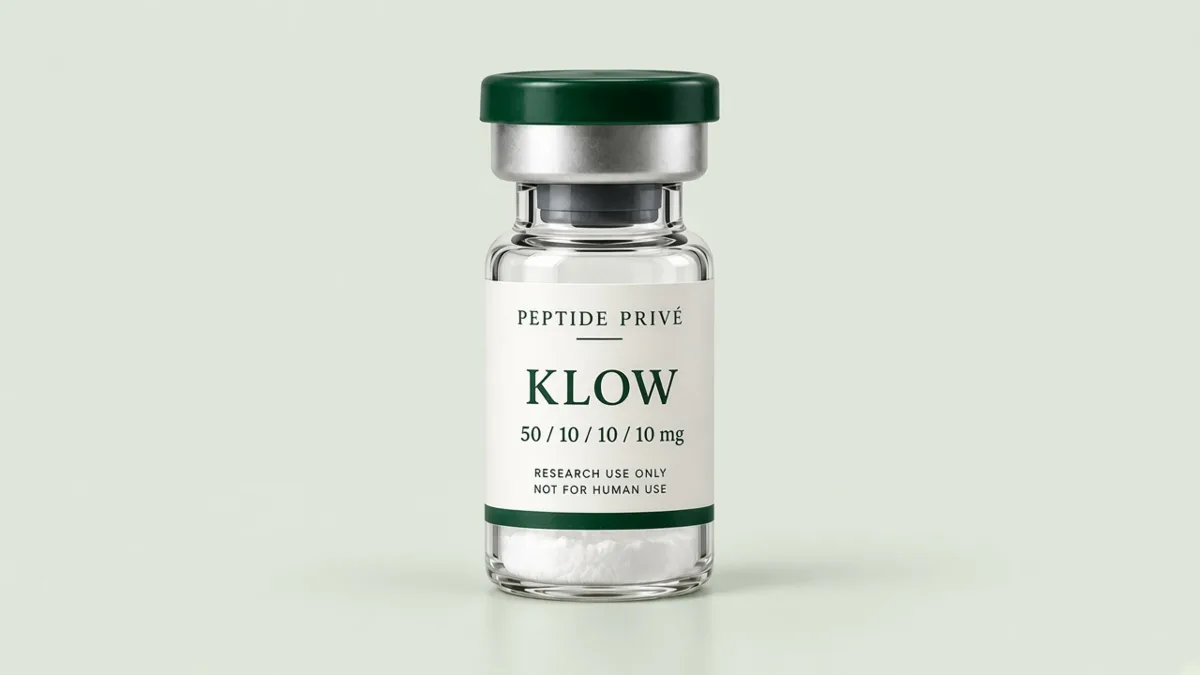
TB-500 is available in our catalog as a component of the BPC-157 + TB-500 blend (10 mg of each), and of the GLOW and KLOW blends (10 mg each). For how a blend label maps each amount to its component, see How to Read a Multi-Peptide Blend Label.
FAQ
Is TB-500 the same as thymosin β4? Not in the doping-control papers, which use TB-500 for the acetylated 17–23 fragment. Always check the stated mass.
Why do equine doping laboratories write about it? Because products sold under the name have been found in equine sport, and laboratories needed mass spectrometry methods to identify them. Those papers are the best public record of what the name has referred to.
What does "Ac" mean? Acetyl: an acetyl group capping the N-terminus of the peptide.
Sources
- Hannappel E. Annals of the New York Academy of Sciences, 2007. PubMed 17468232: https://pubmed.ncbi.nlm.nih.gov/17468232/
- Malinda KM et al. Journal of Investigative Dermatology, 1999. PubMed 10469335: https://pubmed.ncbi.nlm.nih.gov/10469335/
- Sosne G et al. FASEB Journal, 2010. PubMed 20179146: https://pubmed.ncbi.nlm.nih.gov/20179146/
- Ruff D et al. Annals of the New York Academy of Sciences, 2010. PubMed 20536472: https://pubmed.ncbi.nlm.nih.gov/20536472/
- Esposito S et al. Drug Testing and Analysis, 2012. PubMed 22962027: https://pubmed.ncbi.nlm.nih.gov/22962027/
- Ho EN et al. Journal of Chromatography A, 2012. PubMed 23084823: https://pubmed.ncbi.nlm.nih.gov/23084823/
- Delcourt V et al. Drug Testing and Analysis, 2025. PubMed 39314109: https://pubmed.ncbi.nlm.nih.gov/39314109/
- UniProt entry P62328 (thymosin beta-4 sequence): https://www.uniprot.org/uniprotkb/P62328
Every Peptide Privé batch is tested by an independent lab.
Shop all peptides or contact our team with documentation questions.
For in-vitro laboratory research only. Not for human or animal use.