Thymosin alpha-1 (Tα1) is a mid-sized peptide with a long paper trail: it was isolated and sequenced in the 1970s and is now routinely made by chemical synthesis. This profile covers its identity, its history and the checks that matter for a 28-residue, chemically modified peptide.
What Thymosin Alpha-1 Is
Tα1 is a 28-residue peptide with an acetylated N-terminus. Goldstein and colleagues described it as a heat-stable, highly acidic molecule. The "alpha" in the name comes from a nomenclature proposed in the 1977 sequence paper for the family of polypeptides found in a thymus extract called thymosin fraction 5.
| Property | Value |
|---|---|
| Length | 28 residues |
| N-terminus | Acetylated (Nα-acetyl-serine) |
| CAS number | 62304-98-7 |
| Molecular formula | C129H215N33O55 |
| Molar mass | about 3108 g/mol (average) |
How Tα1 Entered the Literature
- 1977: Goldstein and colleagues isolated Tα1 from calf thymus and determined its 28-residue sequence.
- 1977 onward: later work, summarized in Li and colleagues' 2010 review, examined the peptide's effects on T cells, dendritic cells and cytokine production in cell culture and animal models.
- 2004 and 2006: Romani and colleagues reported mouse and cell studies on dendritic cells (see below).
- 2011: Ren and colleagues described making Nα-acetylated Tα1 in Escherichia coli by fusing it to an intein tag. Before that, the authors note, the peptide had been made only by chemical synthesis.
What Cell and Animal Studies Have Examined
Romani and colleagues, working in Perugia, published two widely cited studies in the journal Blood:
- 2004: In mouse models and cultured dendritic cells, they reported that Tα1 changed how dendritic cells matured and produced interleukin-12 after contact with a fungal pathogen, through Toll-like receptor and MyD88-dependent signaling.
- 2006: They reported that Tα1 also induced indoleamine 2,3-dioxygenase in murine dendritic cells and linked this to production of interleukin-10 and regulatory T cells, which they framed as a balance between immune activation and tolerance in those systems.
These are cell culture and animal studies. They describe what was observed in cells and in mice, and they are not evidence of any effect in people.
Why a 28-Residue Peptide Needs More Than a Name
- Modification. The N-terminal acetyl group is part of the molecule. A sample without it has a different mass and is a different compound. Ren and colleagues confirmed acetylation of the N-terminal serine by tandem mass spectrometry for exactly this reason.
- Mass. Their measured mass for the recombinant and the synthetic peptide was about 3107.4 Da, a measured value. Catalog data usually list an average molar mass from the formula, which for C129H215N33O55 is about 3108.3 g/mol. Both describe the same molecule; a good report states which kind of mass it shows.
- Length. At 28 residues, syntheses can contain truncated or modified side products, so purity by HPLC and identity by mass spectrometry are both needed.
Physical Form
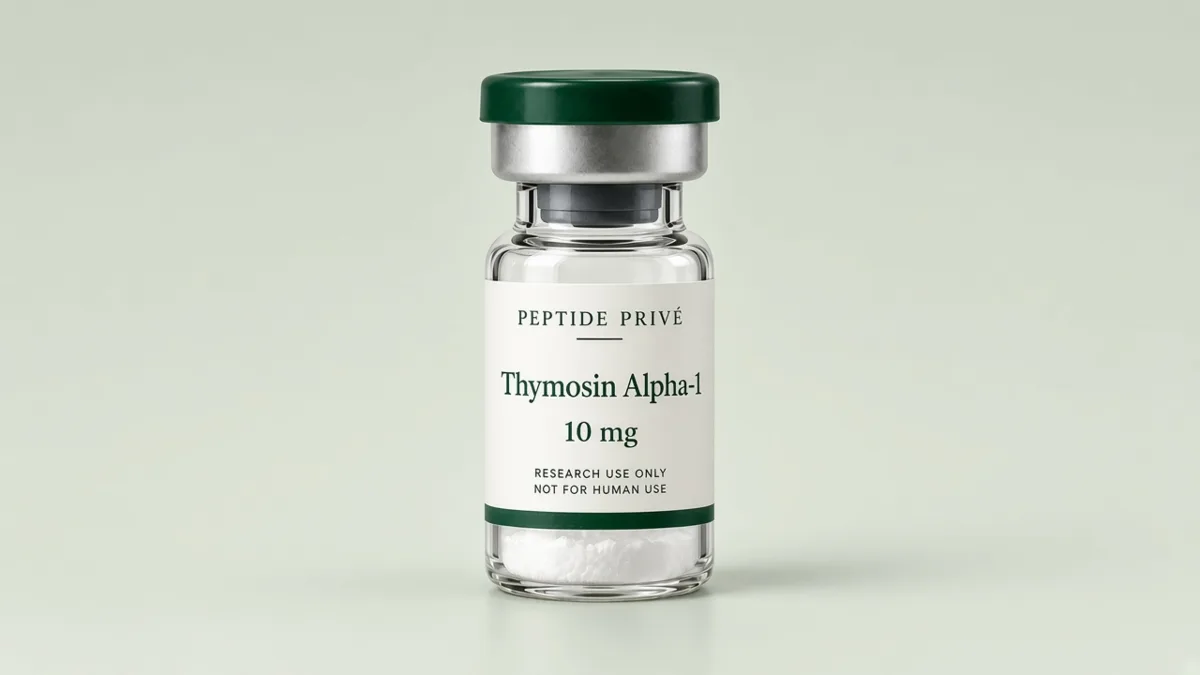
Thymosin alpha-1 is supplied as a lyophilized (freeze-dried) powder, usually white to off-white. Appearance alone does not confirm identity or purity.
Storage and Handling Basics
- Store sealed vials cold, dry and away from light.
- Let a cold vial reach room temperature before opening to limit condensation.
- Record the lot number and the date opened on every vial and aliquot.
- Follow your lab's own stability protocol for any solution you prepare.
Our guide on Storing Lyophilized Peptides in the Lab covers each step in more detail.
What to Check on the Analytical Report
- Lot number: it must match the lot number on your vial.
- Identity: the observed mass should agree with the expected mass of about 3.1 kDa, and the report should say whether it is average or monoisotopic.
- Acetylation: confirm that the report addresses the N-terminal acetyl group.
- Purity: HPLC purity for the lot, with the method and detection wavelength. Compare the purity value with the main peak area and look for shoulders.
For a field-by-field walkthrough, see How to Read a Peptide Analytical Report.
Formats We Carry
Thymosin Alpha-1 is available as a 10 mg vial.
FAQ
Is thymosin alpha-1 the same as thymosin beta-4? No. They are separate peptides isolated from the same thymus extract, with different lengths and sequences. Tα1 has 28 residues. Thymosin β4 has 43. See TB-500 and Thymosin Beta-4.
Is it a hormone? It was first described as a thymic factor. Hannappel's 2007 review of thymosins concludes that none of the peptides isolated from thymosin fraction 5 turned out to be thymic hormones in the strict sense.
Why can the mass on a report differ from the catalog value by about one unit? Average mass and measured mass are different conventions; the report should state which it uses.
Sources
- Goldstein AL et al. Proceedings of the National Academy of Sciences, 1977. PubMed 265536: https://pubmed.ncbi.nlm.nih.gov/265536/
- Romani L et al. Blood, 2004. PubMed 14982877: https://pubmed.ncbi.nlm.nih.gov/14982877/
- Romani L et al. Blood, 2006. PubMed 16741252: https://pubmed.ncbi.nlm.nih.gov/16741252/
- Hannappel E. Annals of the New York Academy of Sciences, 2007. PubMed 17468232: https://pubmed.ncbi.nlm.nih.gov/17468232/
- Li J et al. Peptides, 2010. PubMed 20699109: https://pubmed.ncbi.nlm.nih.gov/20699109/
- Ren Y et al. Microbial Cell Factories, 2011. PubMed 21513520: https://pubmed.ncbi.nlm.nih.gov/21513520/
Every Peptide Privé batch is tested by an independent lab.
Shop all peptides or contact our team with documentation questions.
For in-vitro laboratory research only. Not for human or animal use.